Last week, the Ring Heater around the NI mirror was switched on in order to realign the DET HWS (#39599).
This test was pretty quick, but it was very interesting, since looking at ITF signals allows to better understand the interferometer working point.
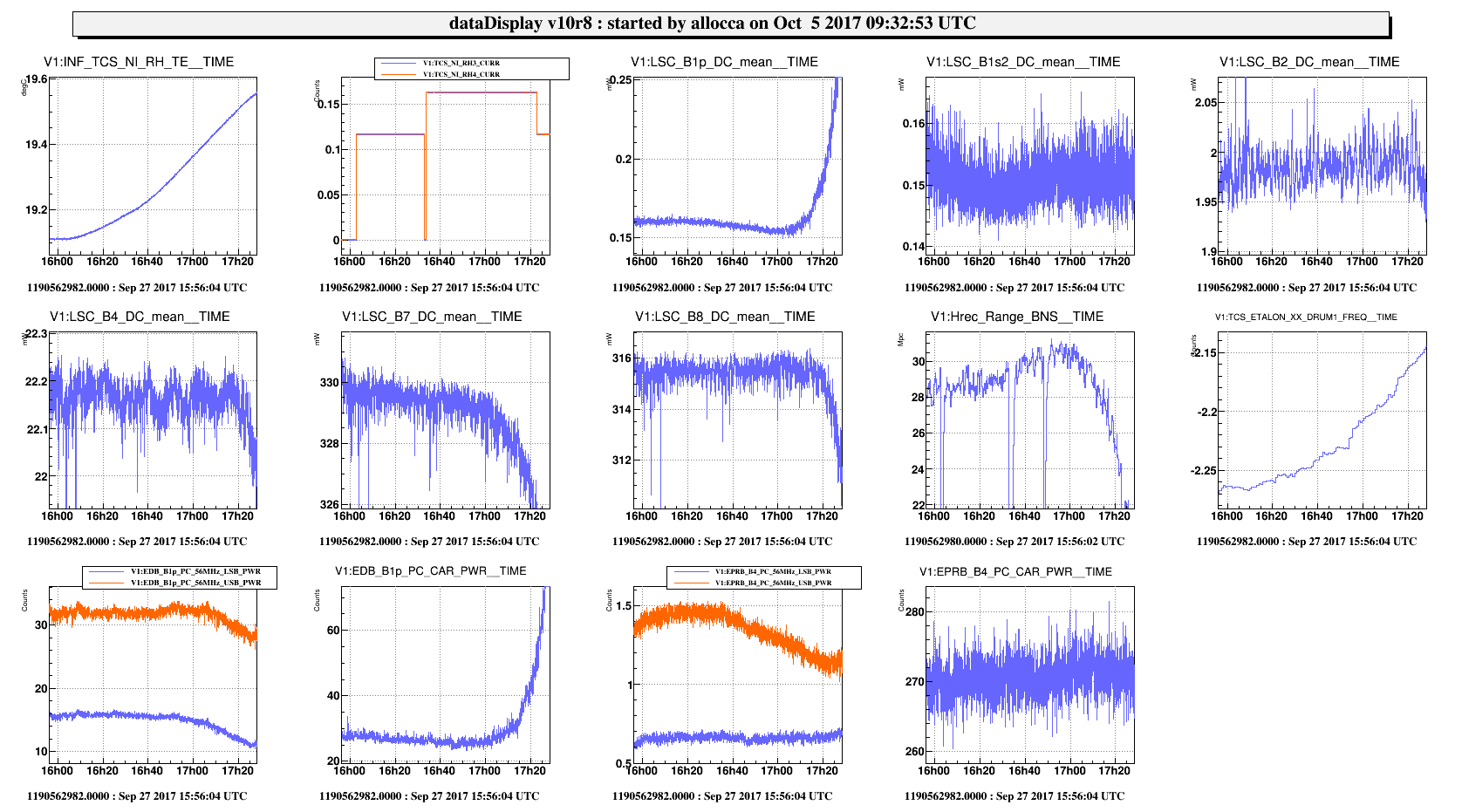
As shown in figure 1, the RH was switched on at around 16.00 UTC. The AA was engaged, and at least for the first part it was able to follow the mirror misalignment due to the wires heating. Then, at around 17.10 it is clearly visible that the alignment is getting worse, so the follwing analysis will mainly regard the time period 16.00 UTC - 17.00 UTC.
The first thing which is worth noticing (and that was already reported in 39605, 39618 and 39621) is that the range increased by about 7% during the first hour. As reported in the linked entries, it also corresponded to a decrease in the sensitivity of some peaks.
The first hypotesis to be verified was whether it could be due to the etalon effect. To check that, we looked at the channel TCS_ETALON_XX_DRUM1_FREQ, which corresponds to the change of the NI TM mode frequency, as reported in a previous study. Here we see a change of 0.06 Hz over the analyzed period, which corresponds to a mirror temperature increase of 0.07K, according to Bas's calibration (39039 , first plot). In order to perform a complete etalon fringe, a temperature variation of 0.3K is necessary, as reported in 35717. Therefore, the observed temperature change would correspond to about one forth of etalon fringe, which in turn would induce an arm cavity power variation of about 0.6% if we were on the steepest side of the etalon curve, or less if we were not in the linear region of the curve. The observed arm cavity power variation (LSC_B7_DC) is of the order of 0.02%, which is very low and barely appreciable. Therefore, it seems unlikely that the range increase is due to the etalon effect. One more thing in support of this hypotesis is that for the etalon effect to take place, the beam should see an OPL increase inside the mirror substrate. However, one hour after the RH switch on, the mirror thermalization was not yet completed, but only the outer heating took place.
In order to better understand the process, we also analyzed the power on B1p, both from the PD and the PC. From LSC_B1p_DC we see a power drop during the same hour, which is also visible in the Phase camera signal (EDB_B1p_PC_CAR_PRW), this latter accounting only for the carrier contribution. One possible hypothesis to explain the power drop both on B7 and on ASY port is related to the diverging lens induced by the RH.This lens is detrimental for the matching to the arm cavity, and it could be the reason why the power decreases. On the other hand, it could be that a diverging lens in the NI ITM is improving the contrast defect.
This process seems unexpected at first sight: indeed, we expected to have a cold converging lens in the WI CP substrate to be compensated by inducing a thermal converging lens in the NI CP.
However, it seems to be on the same line as all the TCS tests performed so far, for which we had to induce an additional converging lens in the WI substrate to improve the contrast defect (35889 , 35867, 37880, ...) .
Do we have a converging lens on the NI (ITM or CP) side?
This deserves further investigations.