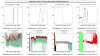
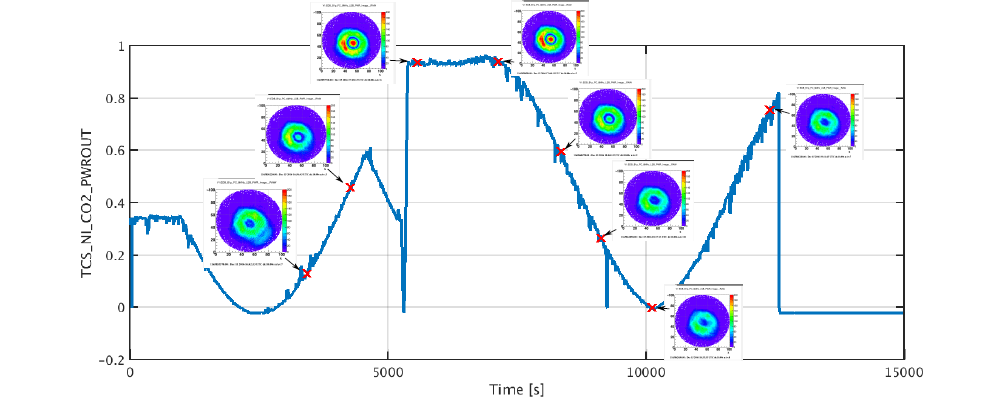
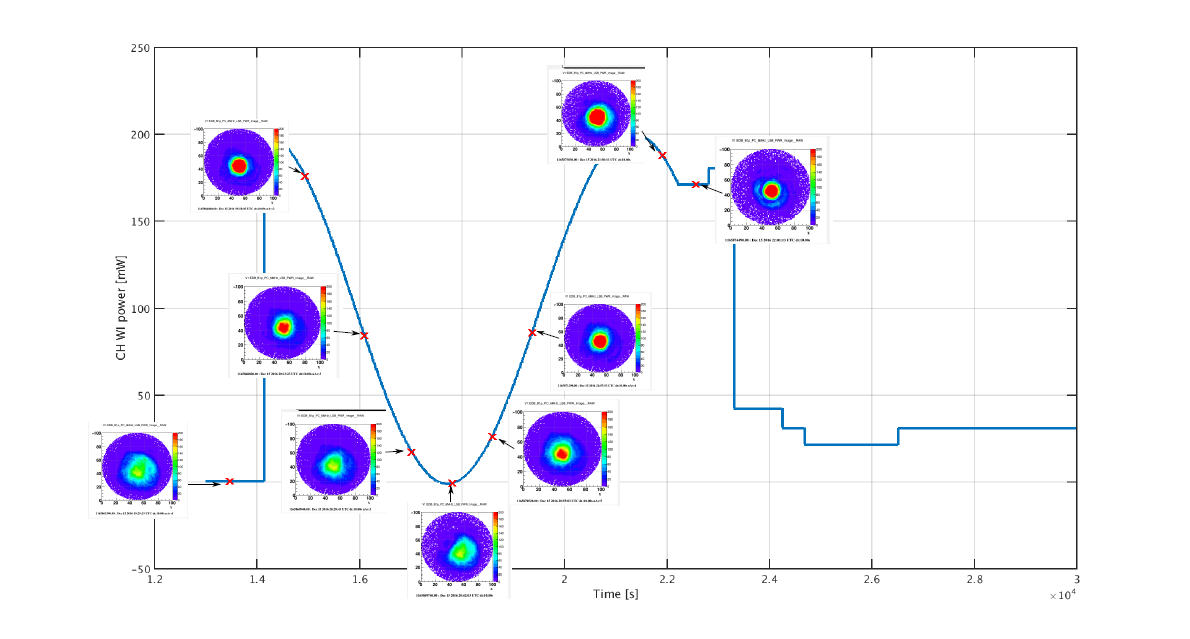
In order to find the best TCS configuration, we applied a sinusoidal power variation to NI CH first and to WI CH later. This was in order to see for which CO2 power we got the best contrast defect.
Both the arms were locked and MICH was locked in DF.
During the measurement, we were monitoring the power circulating in the arm cavities, the power on B1p and the total power in the sidebads as extracted by the phase camera.
We first put a sinusoidal modulation on NI. However, we couldn't get a real decrease of the contrast defect. Therefore, we switched on the same sinusoidal actuation on WI CH, and in this case the minimum of B1p_DC dropped up to less than 5e-4 mW. Figure 1.
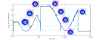
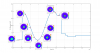
During the measurement we also acquired images with the phase camera. In figure 2 and 3 the power variation of the CO2 beam is shown for NI and WI, respectively. On the top, the images of the Lower sideband power at different times are added. A delay of ~ 700 seconds has been taken into account. The carrier power image was not as significant as the sidebands, since we were locked in dark fringe, and the upper sideband didn't look very different with respect the lower one.
A different beam shape is induced when the North or the West compensation is added. This has to be further investigated.