Reports 1-1 of 1 Clear search Modify search
AdV-SBE (EIB-SAS commissioning)
bulten, melo - 0:30 Thursday 20 August 2026 (69600) Print this report
EIB extra noise
Since the intervention from friday Aug 14 we have extra noise. Suzanne succeeded in balancing the EIB again monday; I cannot use the MOTORSAS_EIB gui in thinlinc from remote, it keeps crashing.
Nevertheless, we have some extra noise in the band 1-10 Hz. I checked all raw signals (voice coils, geophones, LVDTs) and they seem all correct. I switched off the MotorSAS process in the vpm, since the driver coils can make electronic noise, but that did not change anything. In the evening when Romain gave the green light, I switched off controls, switched on viscous damping, and switched on the full pid. With the full pid the ground motion is damped well below 1 Hz but there is an extra shoulder between 1-10 Hz. I think it arises in Tx and Tz and is coupled to Ty,x,z via the tilt stabilization but this is just conjecture. Suzanne did not find anything rubbing against the bench, but maybe there is some small detail. I did not see much difference in acoustic noise (such an effect on the bench, bypassing the floor, could maybe cause such a shoulder) and I checked that the actuators and pid have the same transfer functions as last week (plotting the transfer function from actuator current to bench motion) so it is difficult to find the cause of the extra noise now; it seems all sensors and actuators are performing as well as last week,

The only "large" difference is that there is now some 10 times more noise at the secondary microseismic peak (0.3 Hz); this peak is damped well. It should not spoil the pid at 3Hz, but we may hope for improvement on a quieter day.

Included are the files of the d.o.f. and time signals of the actuators with actuation off/only viscous (first attachment), actuation off/pid (second attachment), a comparison to last week (3rd file), and the raw signals/seismic motion for today and last week (4th and 5th file). The excess noise shoulder is obvious, but the damping is good at 0-1 Hz and similar at +10 Hz.
Non-image files attached to this report
Comments to this report:
melo, gosselin, ruggi - 15:35 Thursday 20 August 2026 (69615) Print this report

At 14:00 LT, we went into the LL to perform a more detailed inspection of the EIB bench. We first put the beam in scan mode and blocked it at the LB output.

We then opened the bench controls and slightly moved the plexiglass tube leading to the SIB1 tower, as it appeared to be in slight contact with the bench. However, a comparison of the FFT signals before and after the intervention showed no significant change, suggesting that the contact was not the cause of the excess noise. No other obvious issues that could explain the increased noise were identified during the inspection.

We then unblocked the beam, re-locked the INJ system, and left the LL at approximately 14:40 LT.

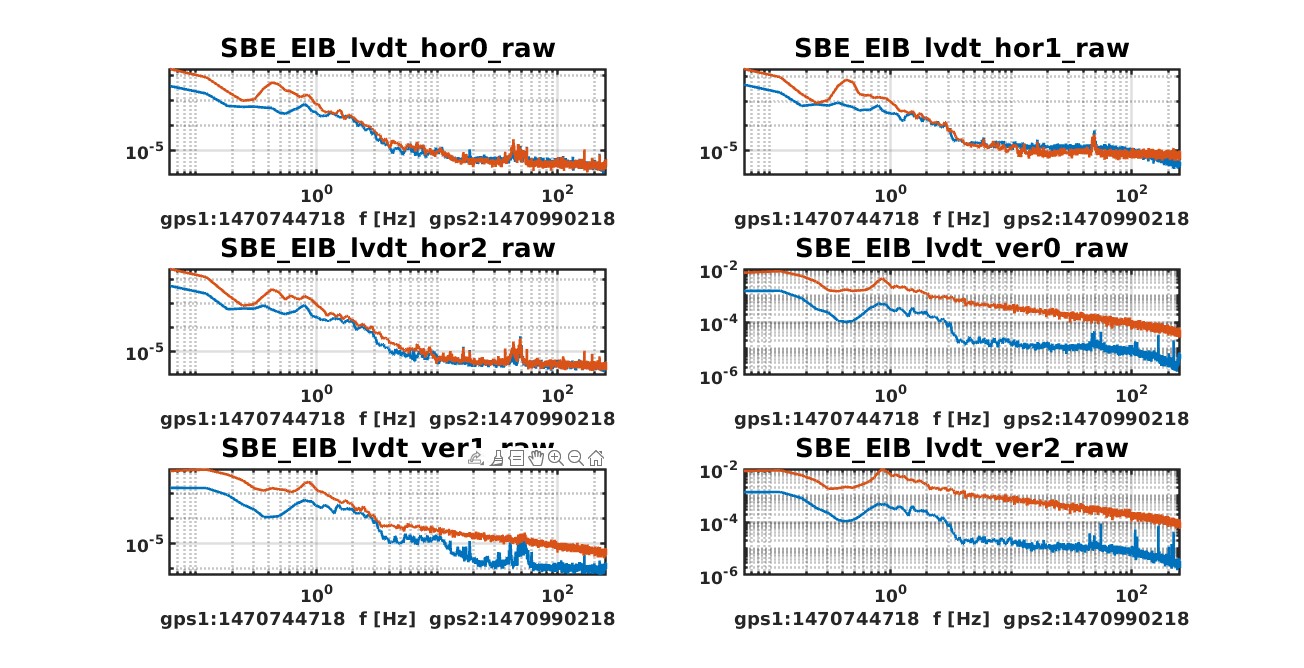
Afterwards, we continued analysing the data. Paolo identified some LVDT signals, particularly the vertical 0 and 2 channels, that are significantly noisier than they were previously (see Fig. 1). A similar issue appears to have occurred in the past (see #57229), where the solution was to implement a low-pass filter to attenuate the excess noise.

It would therefore be useful to investigate whether this filter is still correctly implemented and functioning, or whether another issue is currently responsible for the additional LVDT noise.
 

Images attached to this comment
bulten - 23:53 Friday 21 August 2026 (69618) Print this report
Suzanne blocked the laser beam and told me that I could try and implement filtering for the LVDT noise until monday morning.
I spent friday afternoon/evening to implement lower blending in the pid for the vertical d.o.f. of the external injection bench.
We blend the LVDTs with the geophones on the bench, and also with the ground geophones. The LVDT measure between bench and ground and we subtract ground noise (LVDT_y is the LVDT signal, LVDT_yb contains added ground monitoring geophone, and GEO_y is the geophones on the bench, etc). The geophones and LVDTs are then blended with an (s+s0)^5 filter. For the horizontal LVDTs, which still show normal noise so below 1 nm/sqrt(Hz) above 3 Hz, we blend at s0 =6 (almost 1Hz), since blending at the resonances of the bench is problematic. For the vertical d.o.f., for which the geophones suffer less from tilt, I changed that first to s0=3 (0.5 Hz); this gives a good improvement but still extra noise from the low-passed LVDTs spoil the optimal resolution at 1-5 Hz; therefore I tried s0=2. From the transfer function between LVDT and geophone (with pid control off, so large excursions) we see that the geophone and LVDT are in agreement above 0.1 Hz (both phase and amplitude; below 0.1Hz the geophone has lots of extra noise and the phase difference becomes problematic.

Filtering at s=2 for the vertical channels seems to work fine; although I am not completely sure if the reconstructed blended displacement peaks at 0.2-0.3 Hz are reliable. Both the LVDT and the geophone give more strength than the blended signal which is damped in the loop, but also the raw Geophone and LVDT signals are damped a lot so I think that the situation is OK.
We do have still a little bit of extra noise, but that is at the 20% level, whereas the LVDT noise in the range 1-100 Hz is about 100x higher than it used to be. When the electronic LVDT noise disappears, we can change back the filters.

plots: oldblending: the low and high blending signals for Tx before change of filters, blending at 1Hz
blending_s3noact - blending at 0.5Hz, no actuators on
blending_s2_viscous - blending with viscous control, at s=2 (0.3 Hz)
blending_s2_pid - blending with the PID loop closed
dof_blended : the geophone, LVDT, and total bench blended signal with the PID loop closed
aug13 : the same plot before the EIB intervention, and before the issue with the noise in the vertical LVDTs.
at 3 Hz we reach nm/nrad per sqrtHz now, just as before.
I keep the loops closed; EIB is ready for science mode again.


Non-image files attached to this comment
direnzo, gosselin - 18:17 Tuesday 01 September 2026 (69680) Print this report

To investigate the excess noise in the vertical LVDTs, I performed a brute-force correlation analysis with BruCo, using all ENV and INF channels over the GPS interval identified in #69615.

The results, available at this link, show that the seismometers and accelerometers around the EIB are correlated with the excess noise below 10 Hz. However, these correlations may simply witness the excess motion measured by the LVDTs, rather than provide information about its origin. No other noteworthy correlations were identified.

Search Help
×

Warning

Error

The present report has been modified outside this window. Please check for its integrity in the main page.

Refreshing this page will move this report into drafts.

×