Reports 1-1 of 1 Clear search Modify search
Environmental Monitoring (Environmental Monitoring)
fiori, paoletti, tringali, romero - 13:52 Tuesday 28 April 2026 (69040) Print this report
magnetic comb since April 20th

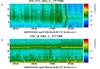
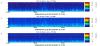
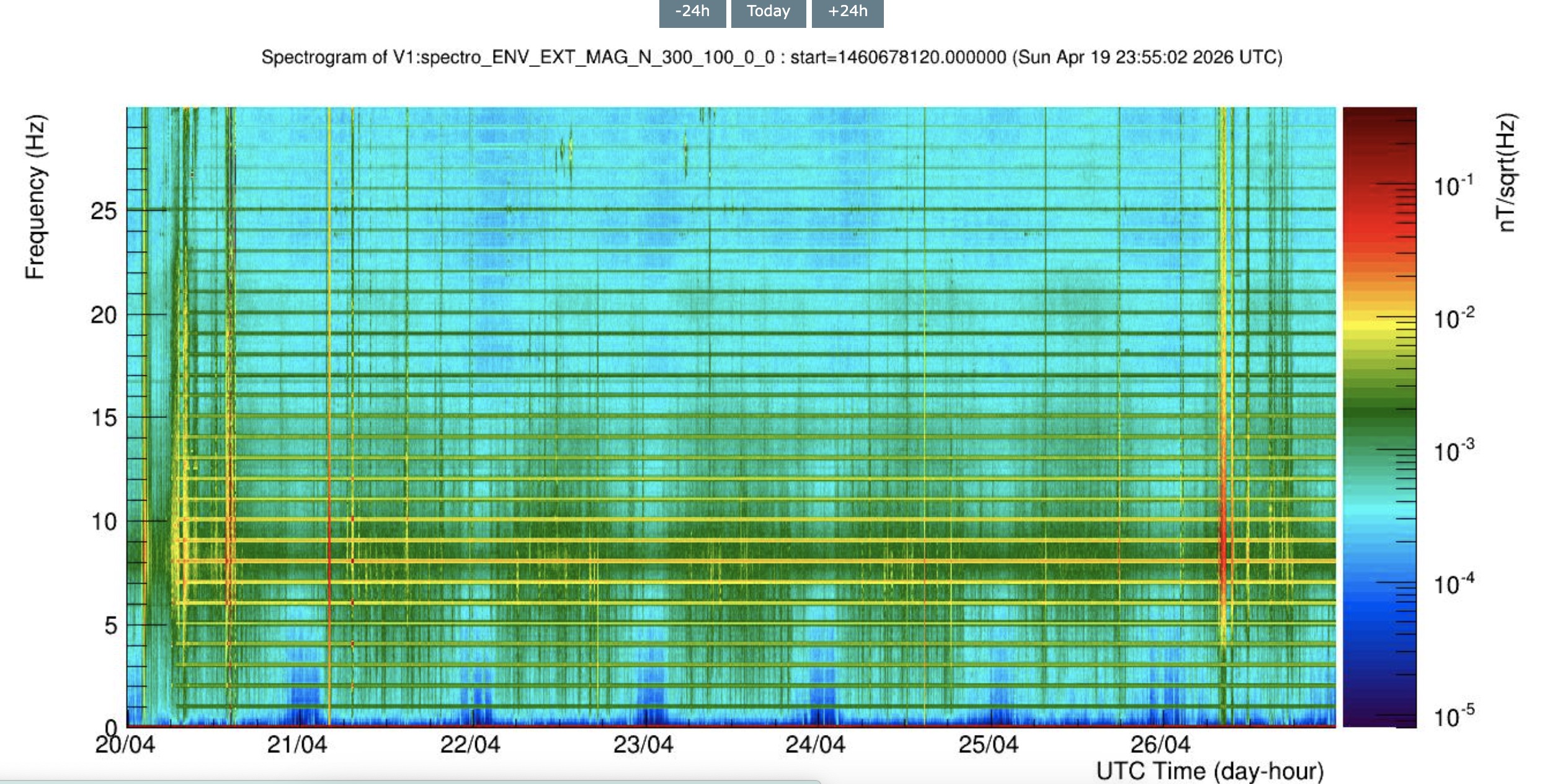
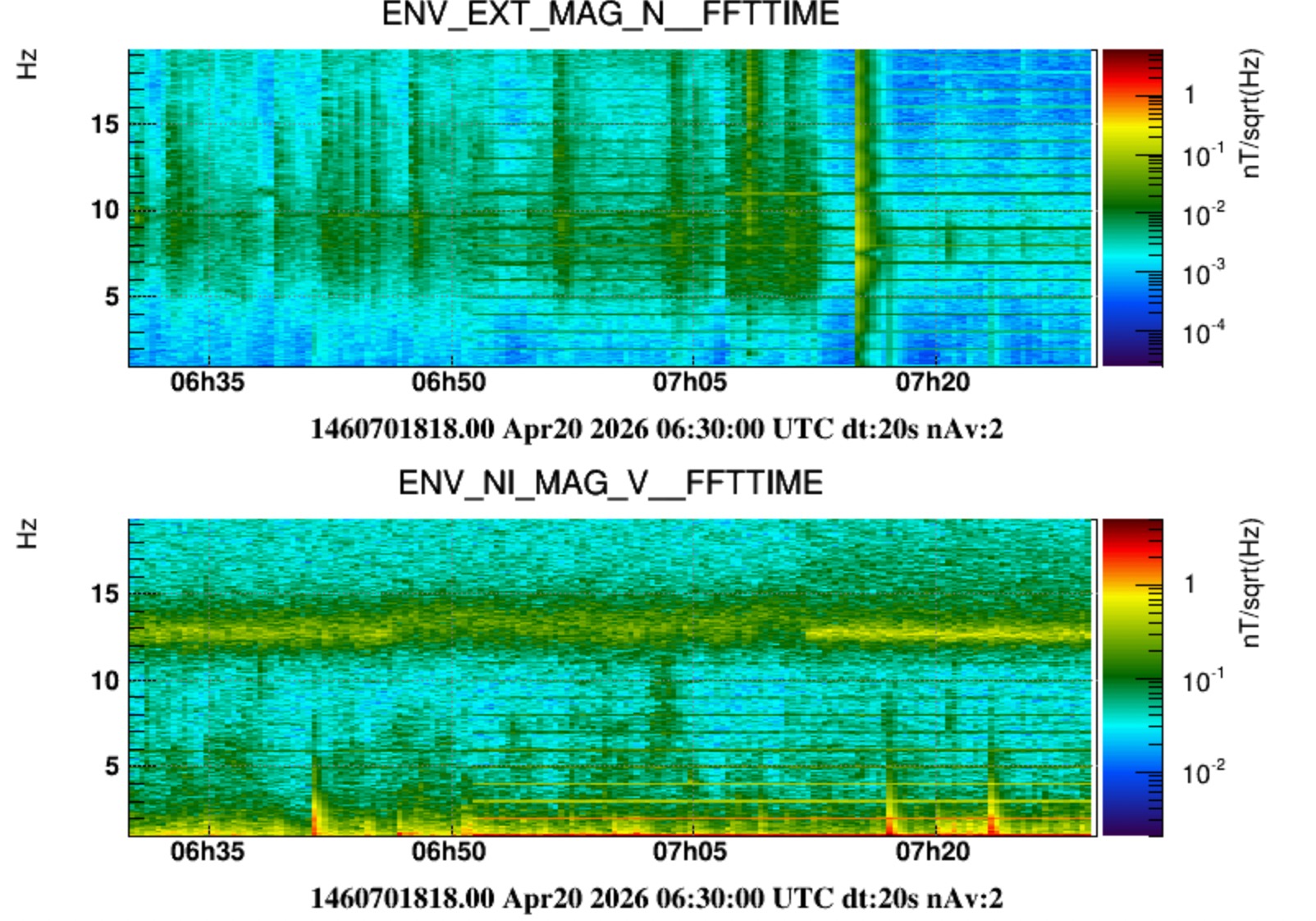
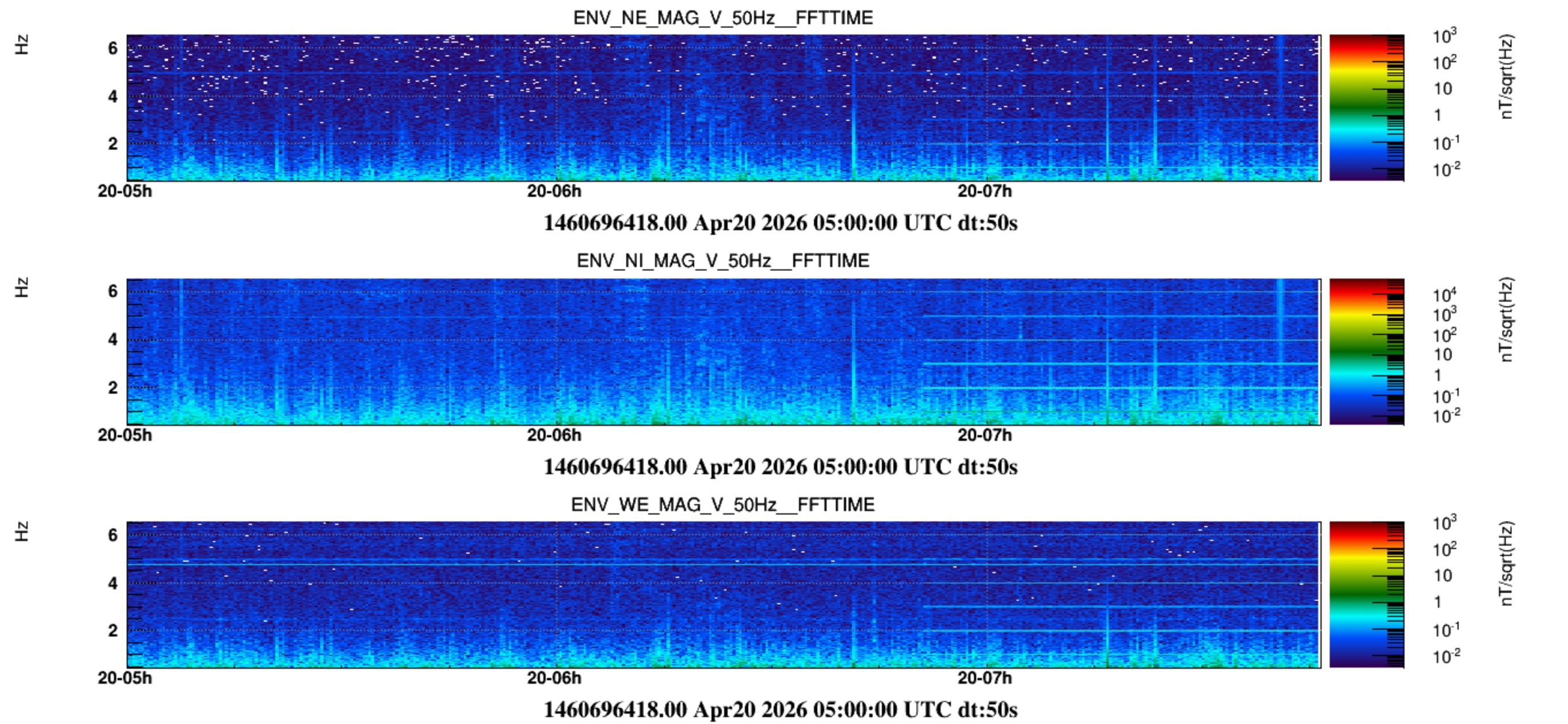
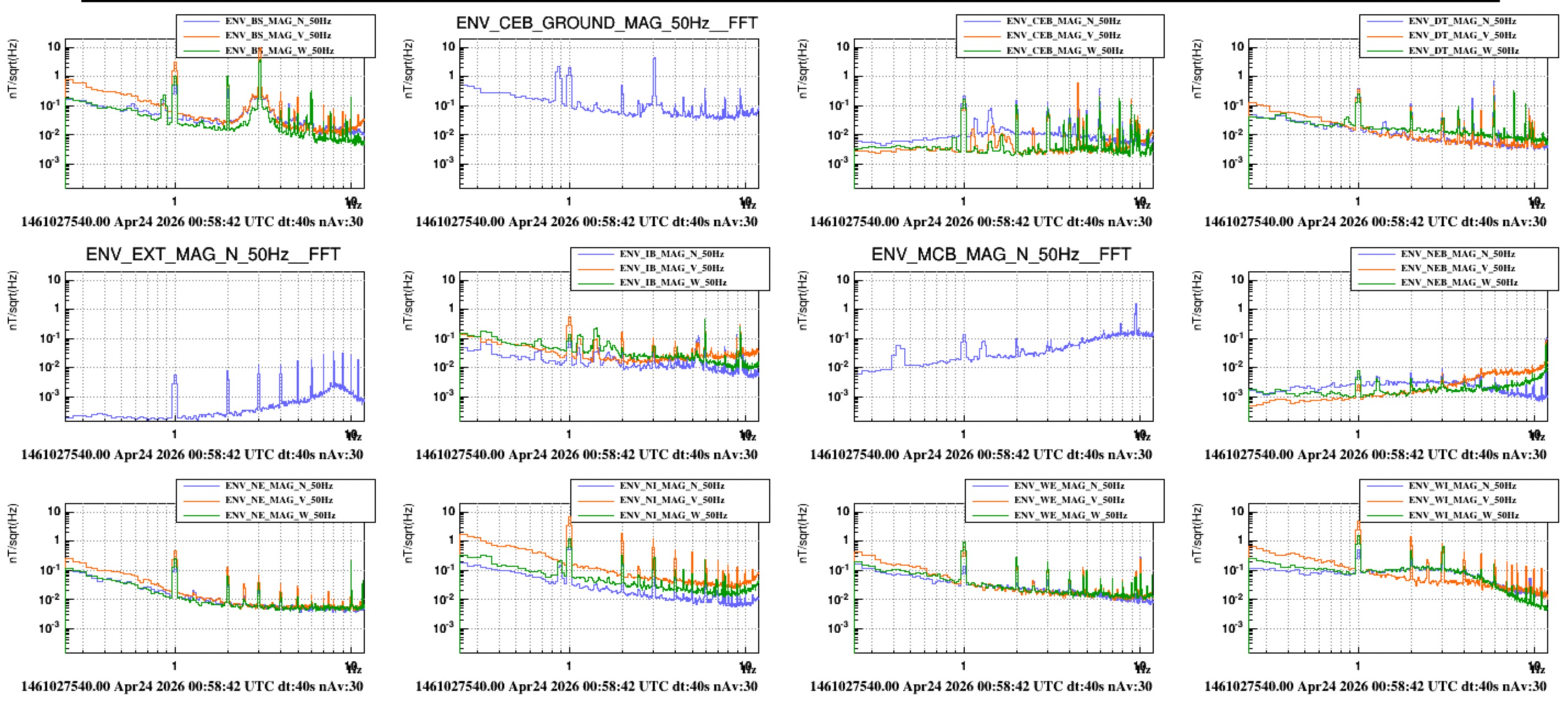
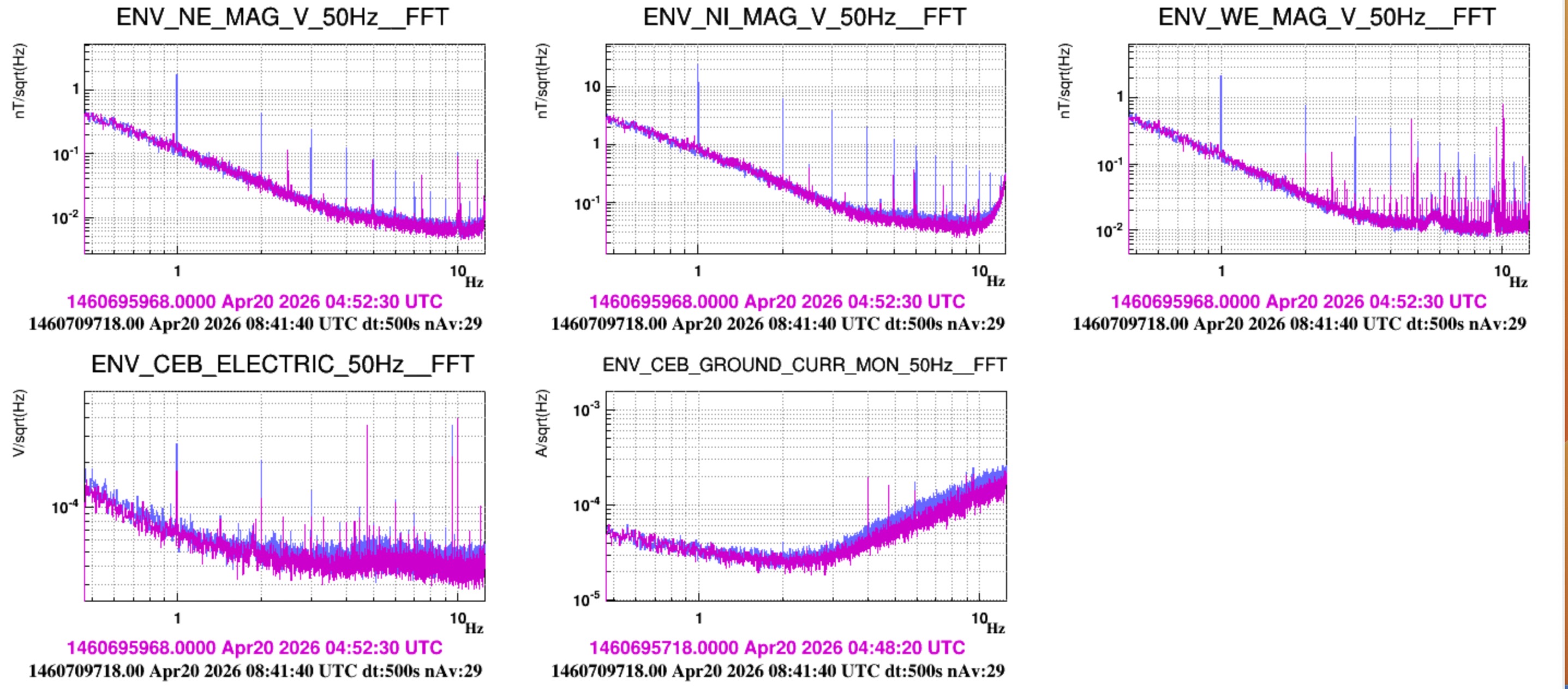
One week ago (Monday April 20th) at 6:50 UTC (8:50 LT) a magnetic comb with 1Hz spacing turned on, and it has been on since then. The origin is still unknown. The noise is mostly affecting up to few tens of Hz, and has the characteristics of a clock driven noise, yet it is somehow intense and widespread. Here is what we observed so far:

  • the noise was first noticed in the external magnetometer (thanks Renato)
  • the source is most likely DC-powered since the noise is not consistent with 50 Hz sidebands
  • comb lines are very narrow, with at least ms stability, and this points to some clock driven device.
  • the noise is louder (a factor 10 to 100 louder than EXT) in CEB magnetometers and in magnetometers close to towers. NI, WI, BS are the loudest.
  • the noise is present also in  the NE and WE magnetometers (curious!) where it started at the same time as for CEB
  • no evidence of noise is seen in any VOLT, CURR sensor (UPS or IPS), as well as nothing in the grounding monitor
  • the ELECTRIC monitor seems to show a factor two increase in the amplitude of lines at 1,2,3,4 Hz.
  • Large coils are all off: VPM processes tell that all coils relay are set to 0, and in addition CURR and VOLT coils monitors do not see any noise
  • the logbook does not report any concurrent operation
  • VAC team and Davide are not aware of any new hardware or operation at that time
  • the VPM log does not report any action at that time
Images attached to this report
Comments to this report:
fiori, quemener, tringali, washimi - 15:08 Friday 05 June 2026 (69170) Print this report

We investigated further the 1Hz comb noise, which is still present.

Last Friday (May 29) we performed some measurements with one Bartington 3D Magnetometer and the portable spectrum analyzer CoCo80x.

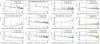
First we found that the noise was present and quite intense close to the vacuum pipe of the W arm. Figure 1 shows the probe position in the first measurement: its tip was approximately 1 cm from the chamber at 900W and so approximately 0.6m from the tube center, the X axis was oriented along the tube, Y was vertical and Z was radial to the tube. In this position, the 1Hz comb field is oriented mainly along Y, being consistent with the field radiated by a current flowing along the tube. This is shown in Figure 2. The intensity is similar to what measured by similar sensors positioned close to vac chambers in CEB: that is a few nT/sqrt for the 1 Hz peak - compare with Figure 3 which uses the same 20s fft window.

The same Figure 2 shows recordings when the same probe was positioned by doubling the distance from the tube center: the field orientation is as well along Y and the intensity approximately halves. This looks consistent with a field being emitted by the beam tube. We then positioned the probe on the tunnel floor (which is the 3rd plot in Figure 2): the intensity is rougly the came but now the B field vector is oriented at 45 deg in the plane perpendicular to the tube, which also looks consistent with a field emitted by the tube.  Yet, when positioning the probe close to the tunnel roof a large signal is noticed (Figure 4). No measured amplification at the ethernet switch box and cables running along the tunnel wall.

We then repeated the measurement close to the tube at 1800W and 2700W: the emitted comb is there with similar intensity and orientation characteristics (Figure 5). This seems to contraddict the hypothesis that the noisy current is generated in CEB and decays flowing outwards along the tubes. While at 1800W we also sniffed the vacuum pump station as well as cables but found no amplification. At 2700W we also took again a measurement close to the tunnel roof, this time being outside. Interestingly the noise disappeared from the probe when positioning the probe in the middle of the nearby road (green track in Figure 5).

We finally took some measurements in the central external area: Figure 6. The comb is present! The signal is particularly intense close to the methan gas pipe tube nearby the guardiania. Il looks that one such pipe runs inside the EGO site along the South fence. We also moved in the external road and towards the location (approx. 100m before the EGO gate) where the SNAM company performed heavy works between February 5th untill the first week of April (Thank you Maria fro recording the dates). The noise level is more or less the same when moving the probe on a tripod at 1.5m above the ground (Figure 6).

Our suspect is that the source of the noise might be related to galvanic anticorrosion currents in the methan pipes, which in the past produced a non stationary 5Hz comb: https://logbook.virgo-gw.eu/virgo/?r=55542. This time instead the noise  is very stationary: the comb is extremely narrow and consistent with a GPS synch device.

A more stringent proof could come from measuring a few km away from EGO, in the locations explored in the past.

Images attached to this comment
fiori - 15:14 Friday 05 June 2026 (69174) Print this report

This morning at around 1AM UTC the external magnetometer detected a decrease (but not disappearence) of the comb noise intensity.

Images attached to this comment
fiori, romero - 17:12 Sunday 07 June 2026 (69177) Print this report

From a message received from our external collaborator Renato Romero:

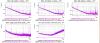
Friday June 5th at 17:30 UTC the 1 Hz comb disturbance stopped completely: Figure 1

Interestingly, in the subsequent minutes are again well visible the disturbances that we attribute to trains: Figure 2


Images attached to this comment
Search Help
×

Warning

Error

The present report has been modified outside this window. Please check for its integrity in the main page.

Refreshing this page will move this report into drafts.

×