Figure 1 shows the power read on the B1p and B1s photodiodes on November 4th when the interferometer was in Low Noise 2. Figure 2 shows the power obtained on the same photodiodes in Low Noise 2, on January 8th, when Michal performed the EDB OMC scan ( https://logbook.virgo-gw.eu/virgo/?r=68456 ).
What is striking is that the power ratio between B1s and B1p is very different. On Nov 4th, the B1s power was about 30% larger than the B1p power. Now the B1s power is about 3 times larger than the B1p power.
We checked the camera images:
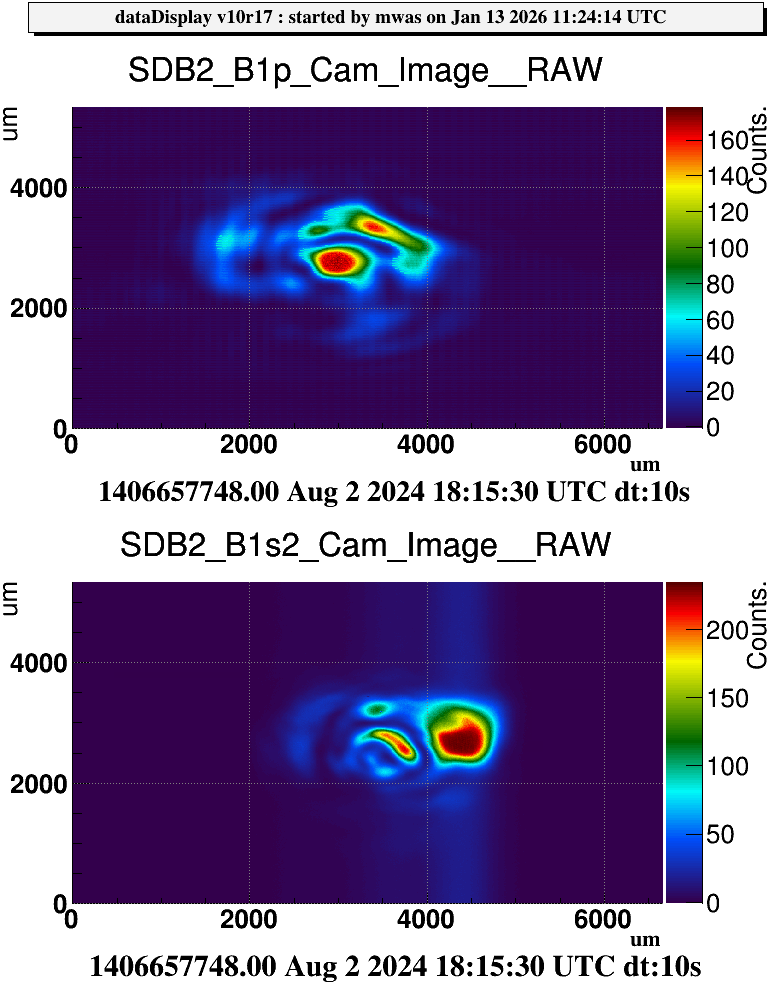
- Figure 1 shows the B1p and B1s images obtained on Nov 4th. B1p camera exposure time is 1000 us, gain = 0. B1s camera exposure time is 1000 us, gain = 5.1.
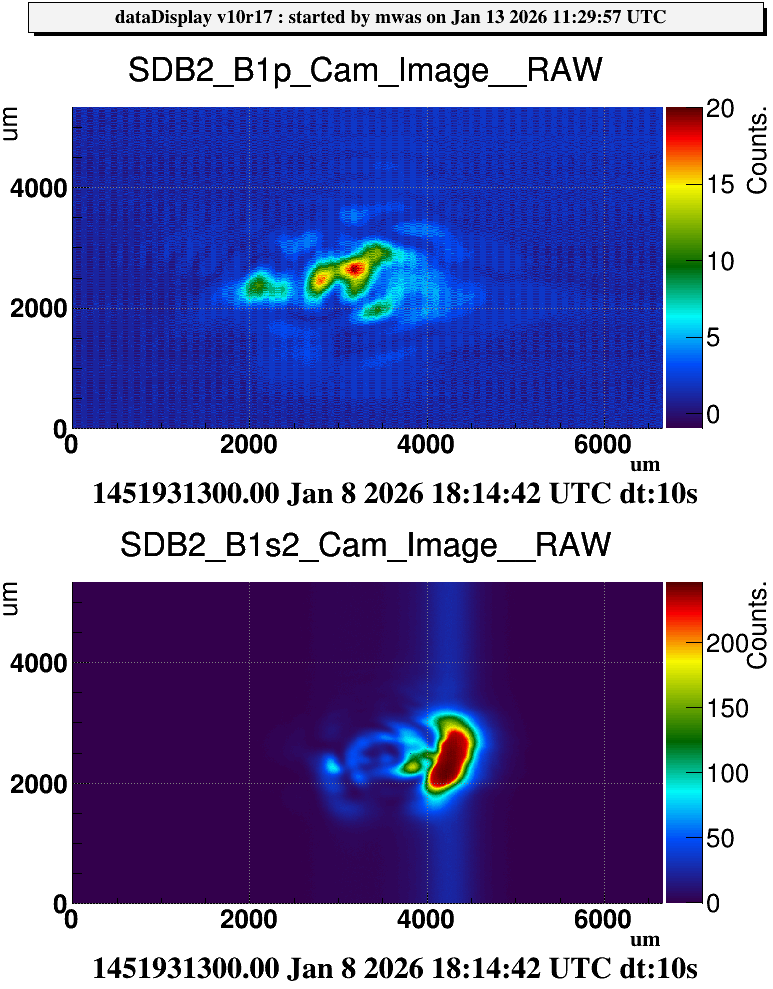
- Figure 1 shows the B1p and B1s images obtained on Jan 8th. B1p camera exposure time is 1000 us, gain = 1. B1s camera exposure time is 1000 us, gain = 5.1.
The most striking difference is the brighter spot on the right side of the B1s camera.
From the test of misaligning the SDB1 bench performed by Michal yesterday ( https://logbook.virgo-gw.eu/virgo/?r=68459 ) it seems unlikely that the bright spot may be due to the beam passing at the edge of the SDB1 mirror coating. Another hypothesis could be that this brighter spot and higher power on B1s is due to a change in the polarization (that could explain a higher transmission through the B1s mirror).
.png)
.png)
.png)
.png)
.png)
.png)
.png)
.png)
.png)
.png)