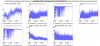
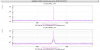
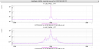
From these figures we see that the noise in hrec_raw stays the same, but that its coherence with LSC_PRCL is decreased when the range is lower. As the noise subtraction are done in a linear fashion, a smaller coherence means it is less able to subtract the noise. In the 100Hz-1kHz band, the PRCL subtraction correspond to subtraction frequency noise coupling due to the arm assymetry (CMRF).
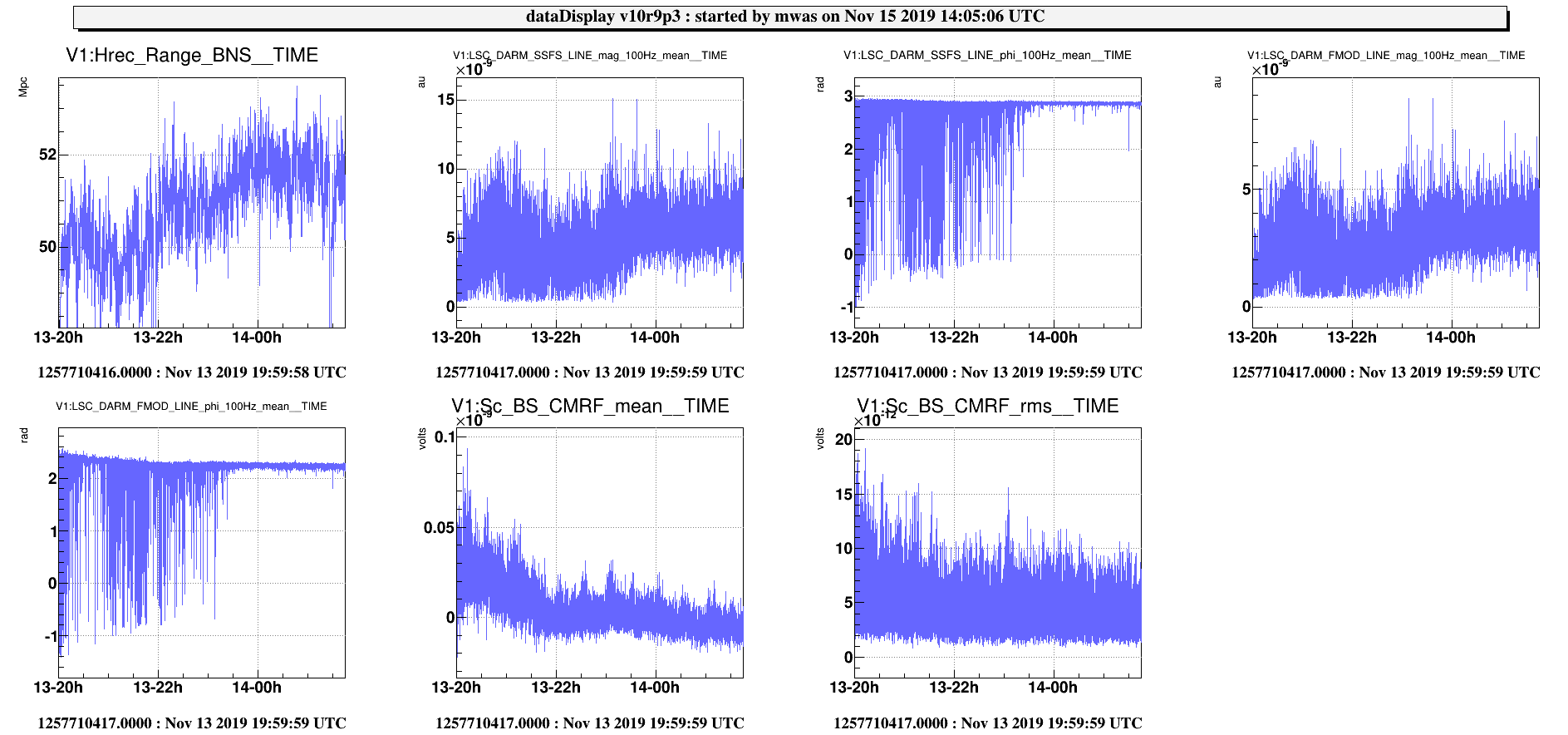
Figure 1 shows the trend of a few channels related to the CMRF. In Sc_BS_CMRF we can see that its mean value get closer to zero and that it fluctuate less. On the 1111Hz and 3345 frequency lines demodulated in DARM we can see that the line moves away from zero, as the magnitude get larger, and the phase stops flipping sign.
I see two potential explanation to the reduce coherence between PRCL and DARM (and hence not as efficient subtraction)
- The CMRF is fluctuating more at the beginning of the data stretch, as the subtraction takes the mean value over 500s to compute the coupling it is not able to subtract the CMRF contribution to the fluctuations
- The CMRF is close to zero as seen on the 1111Hz and 3345Hz lines in DARM, so the coupling is changing sign all the time. As the transfer function is a comple number at each frequency bin, the average around zero may give much worse result, than trying to make an average around a non zero value.
I don't think that explanation 2) is the right one, as everything is linear in the subtraction, so having a zero or non zero mean value should not make a difference, but I may be missing something here. To me explanation 1) is more likely, the arm assymetry is fluctuating more, hence the loss of coherence and the poorer subtraction. The only solution would be to find what is modulating the CMRF (probably some alignment signals), and do a bilinear subtraction. The easiest should be to study the sidebands of the 1111Hz and 3345Hz line to find what is modulating the coupling.
Figure 2 and 3 shows that the "wings" (due to coupling modulation) around the 1111Hz and 3345Hz line in DARM are smaller when the subtraction is working better.