ITF found in LOCKED_ARMS_IR in COMMISSIONING mode.
planned activity:
CARM NULL locking / DAS adjustment (Spinicelli)
Relocked up to CARM_NULL3F after the usual cross-alignment in ACQUIRE_DRMI.
Activity in progress...
ITF found in LOCKED_ARMS_IR in COMMISSIONING mode.
planned activity:
CARM NULL locking / DAS adjustment (Spinicelli)
Relocked up to CARM_NULL3F after the usual cross-alignment in ACQUIRE_DRMI.
Activity in progress...
The vertical mode of PR mirror (11.6 Hz) gets randomly excited during the lock acquisition; the lock can even become unstable on that (orthogonal) resonance because of variable and not predictable coupling of PRCL sensing to PR vertical motion.
A possible way to control the instability is to send a fraction of the longitudinal correction to the marionette vertical actuation. That sort of damping works for the arm test masses and is used to reduce a similar instability occurring on WI during the lock acquisition. Unfortunately the same strategy doesn't work with PR, because the coupling seems to have different sign at different steps of the lock acquisition.
For that reason we decided to implement a true local damper of PR mirror vertical mode, using as error signal the vertical LVDT which measures the relative motion of filter7 and its crossbar. F7 crossbar is part of the 3 bodies system (mirror-marionette-crossbar) for which the 11.6 Hz mode is one normal mode of resonance. The LVDT signal is sensitive enough to see the peak when the instability becomes large and a loop can be effective in reducing the Q of the mode, but we have to pay attention on the possible noise injected on the payload by a local control.
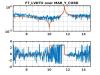
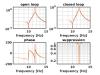
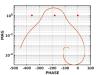
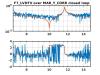
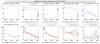
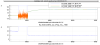
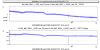
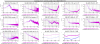
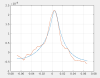
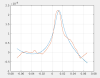
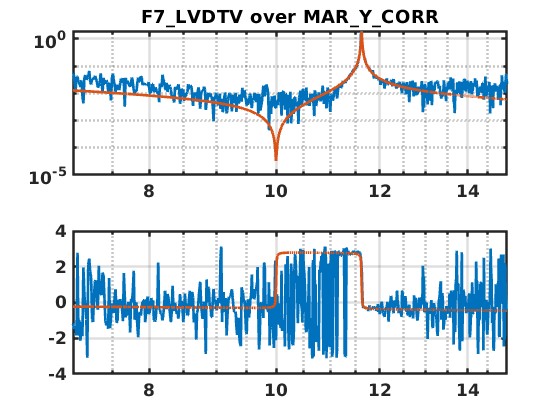
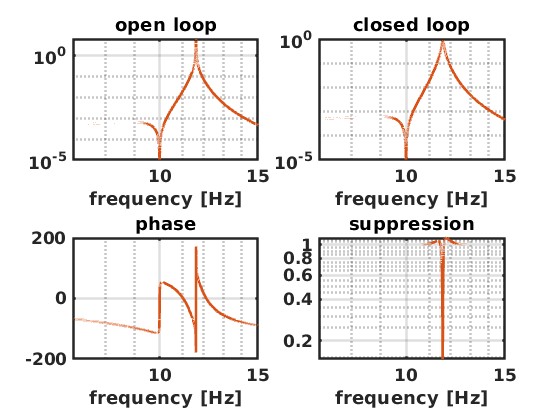
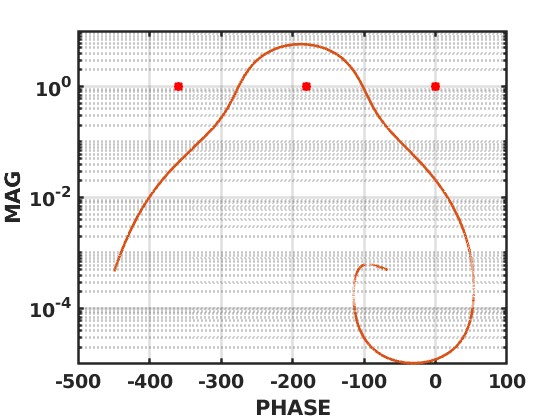
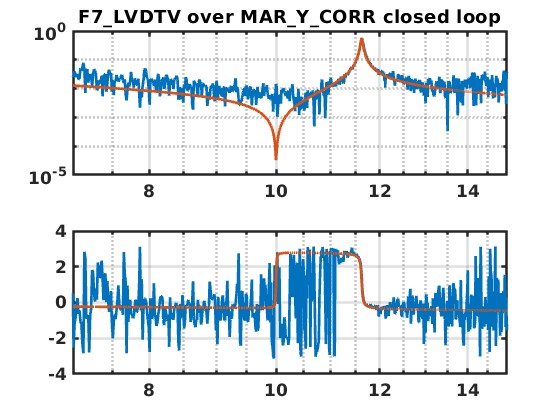
A measurement of F7 LVDT response to MAR_Y_CORR has been measured and fitted (fig 1). The fit requires a high quality factor, at least 1000. A narrow band loop around 11.6 Hz has been developed (fig 2, fig 3). Repeating the TF measurement with the loop closed, the Q appeared to be lowered down to 300 (fig 4).
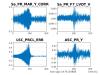
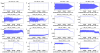
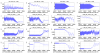
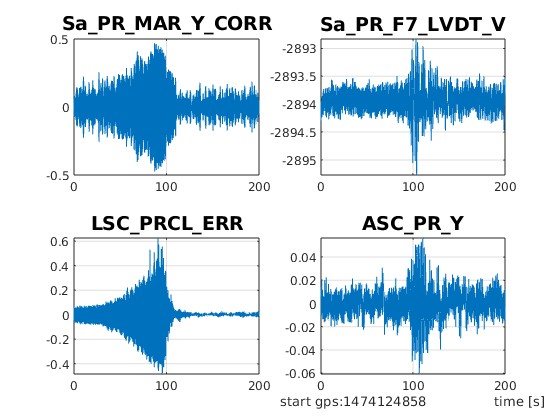
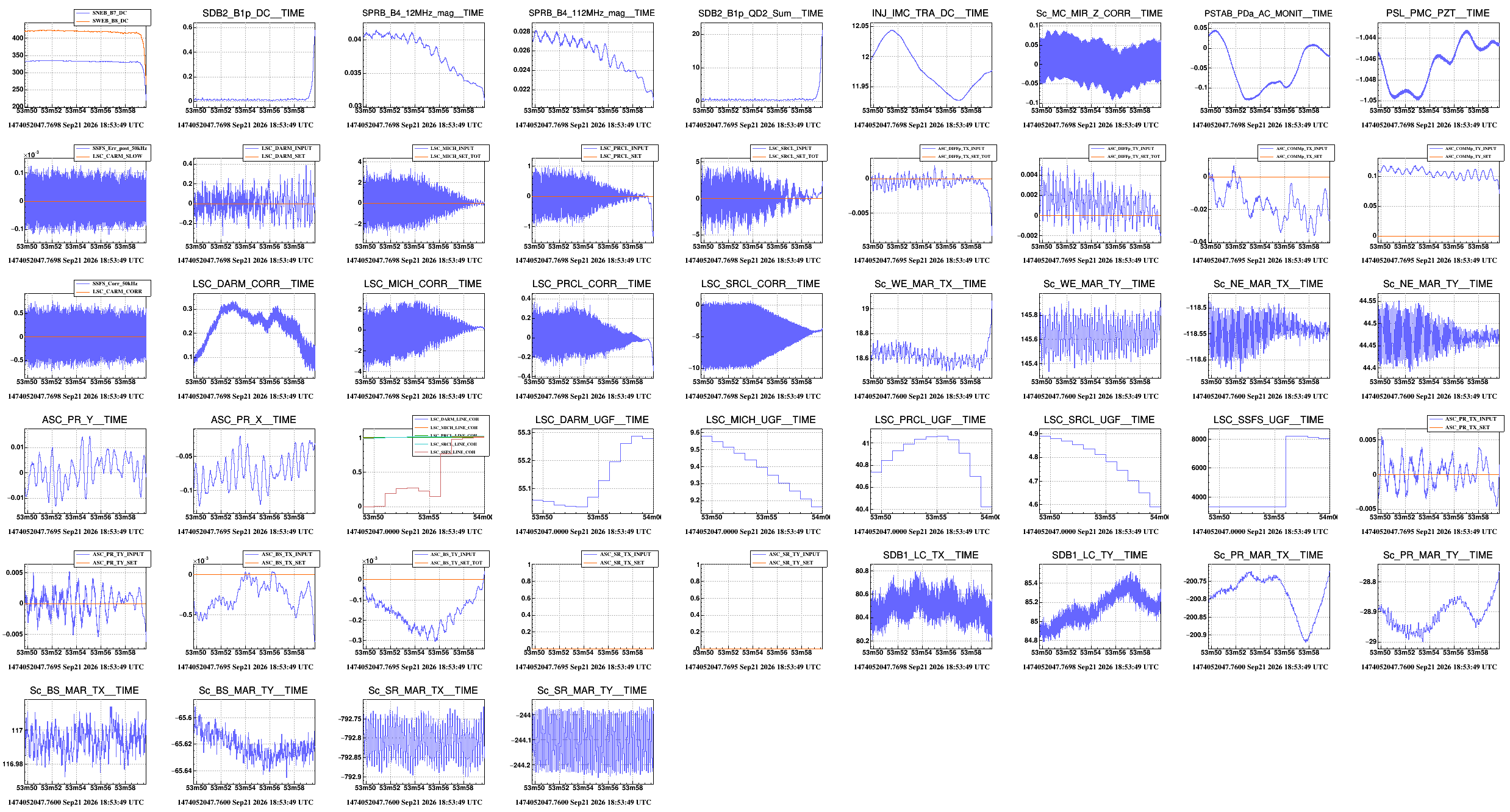
The damper has been tested during a lock acquisition, when the 11.6 oscillation had reached a very high level, well visible everywhere (fig 5 - the probe Sa_PR_MAR_Y_CORR is the output of the damper, which was actually not sent to the actuator when the resonance was growing). The damping have been quite effective and fast, but during its action some low frequency motion of the payload was induced. This is visible on F7 LVDT and also on the quadrant signal used in loop for the beam control (ASC_PR_Y), saying that the action induced a small excess of PR vertical motion and beam angular fluctuation. The excess noise disappeared when the steady state was reached, so I would assume that the noise of the damper is negligible, but the lock did not last enough to check better. Anyway, given the effectiveness of the damper, I decided to reduce its gain by a factor of 3 and leave it permanently in operation. A long lock in CARM NULL is needed to see if this gain is enough to guarantee the stability at 11.6 Hz.
A possible improvement can come from a swap between the local sensor and the quadrant in CARM NULL: the SNR of the quadrant is quite better, but that signal is available only in CARM NULL, while the 11.6 Hz can affect the lock also in the previuos steps.
This morning at 7.25 UTC we set the PR CHROCC (V_DAC) from 3.88 V to 4.28 V with a ramp of 300 s.
The ITF lock recovery went on all the afternoon without succeeding to achieve a stable lock at CARM_NULL_1F (#69796); activity stopped at around 19:20UTC. I left the cavities locked on the infrared.
Sub-system reportsSUSP
at 18:30UTC the WI local controls opened by the guardian following the unlock, properly closed; I wasn't able to use the suspension GUI.
at 19:09UTC the WE local controls opened by the guardian following the unlock, properly closed; again I wasn't able to use the suspension GUI.
- we reverted all the locking parameters to friday 18th at 12 UTC
the carm null 1f was not reachable (no loop oscillations), so we started to remove part to try to survive
- removed COMMp, CARM slow, alpha and Soft
the lock was killed by instabilities on the dark fringe, so Michal raised the shutter treshold to 0.027
we then tryed to lock with SR misaligned (-2urad ty) and we increased the jumps rate, see Figure 1.
The lock behavior is not predictable and no loop oscillations are present. It could be that we are too close to the cavity instability.
In agreement with the commissioning crew, I reverted all the steps performed over the weekend to return to the last configuration we had on Friday (STEP 8, entry 69755) when the lock acquisition seemed to be reliable. The main goal was to try HWS-DET acqusitions in order to veirfy the situation of PAs on the NI mirror.
Activity completed at 10.30 UTC.
Here the TCS settings:
|
|
| CH [W] | INNER DAS [W] | OUTER DAS [W] |
| W | on the ITF | 0.044 | 0 | 1.08 |
| on the pickoff | 0.272 | 0 | 0.180 | |
| N | on the ITF | 0.040 | 0.18 | 0.72 |
| on the pickoff | 0.247 | 0.029 | 0.118 |
At the end of the transient, during the afternoon shift, we resumed the lock acquisition attempts, but the same issues observed yesterday persisted.
- we reverted all the locking parameters to friday 18th at 12 UTC
the carm null 1f was not reachable (no loop oscillations), so we started to remove part to try to survive
- removed COMMp, CARM slow, alpha and Soft
the lock was killed by instabilities on the dark fringe, so Michal raised the shutter treshold to 0.027
we then tryed to lock with SR misaligned (-2urad ty) and we increased the jumps rate, see Figure 1.
The lock behavior is not predictable and no loop oscillations are present. It could be that we are too close to the cavity instability.
ITF found in locked arms.
At 6:00 UTC started the planned maintenance, below the list of the activities communicated in control room:
All the maintenance activities completed around 11:00 UTC; then started the planned commissioning activity of ISC.
R. Cavalieri, F. Nocera, P. Spinicelli
This is to detail the RF Modulation configuration we are likely to use for IR1.
Starting today, the 22 MHz sideband is generated with a single-output DDS, as per AdV baseline design.
In an attempt to have a fallback plan for the remaining interferometer RF sidebands generation heading towards IR1, we have tried to verify the phase noise of the LNFS referred to an Synth4 in https://logbook.virgo-gw.eu/virgo/?r=69715, i.e. the one which did not turn on, after hacking our way around the power-on issue (we've tracked down the problem to a failure of one of the two AC-DC converter, the one for the +5Vdc, that we bypassed using a bench power supply in its place).
We verified its phase noise performance are not in spec but they are comparable or better than the one currently in use for 6, 8, and 56 MHz. In addition channel three seems to be working as well, contrary to what has been observed in the last few days in the Lab.
The serial communication works ok.
We have left it on but, at this time, not connected to the modulation chain.
The situation therefore is shaky (the "spare" relies on an external power supply, channel 3 reliability is uncertain) but not as bad as it looked yesterday.
This morning we swapped the LNFS that generates the 22.3 MHz used for IMC longitudinal and angular controls with a DDS.
This LNFS is the one with the communication problem. It will be sent for repair.
When resetting the output frequency and amplitude of the DDS to nominal values the IMC relocked and so did the RFC.
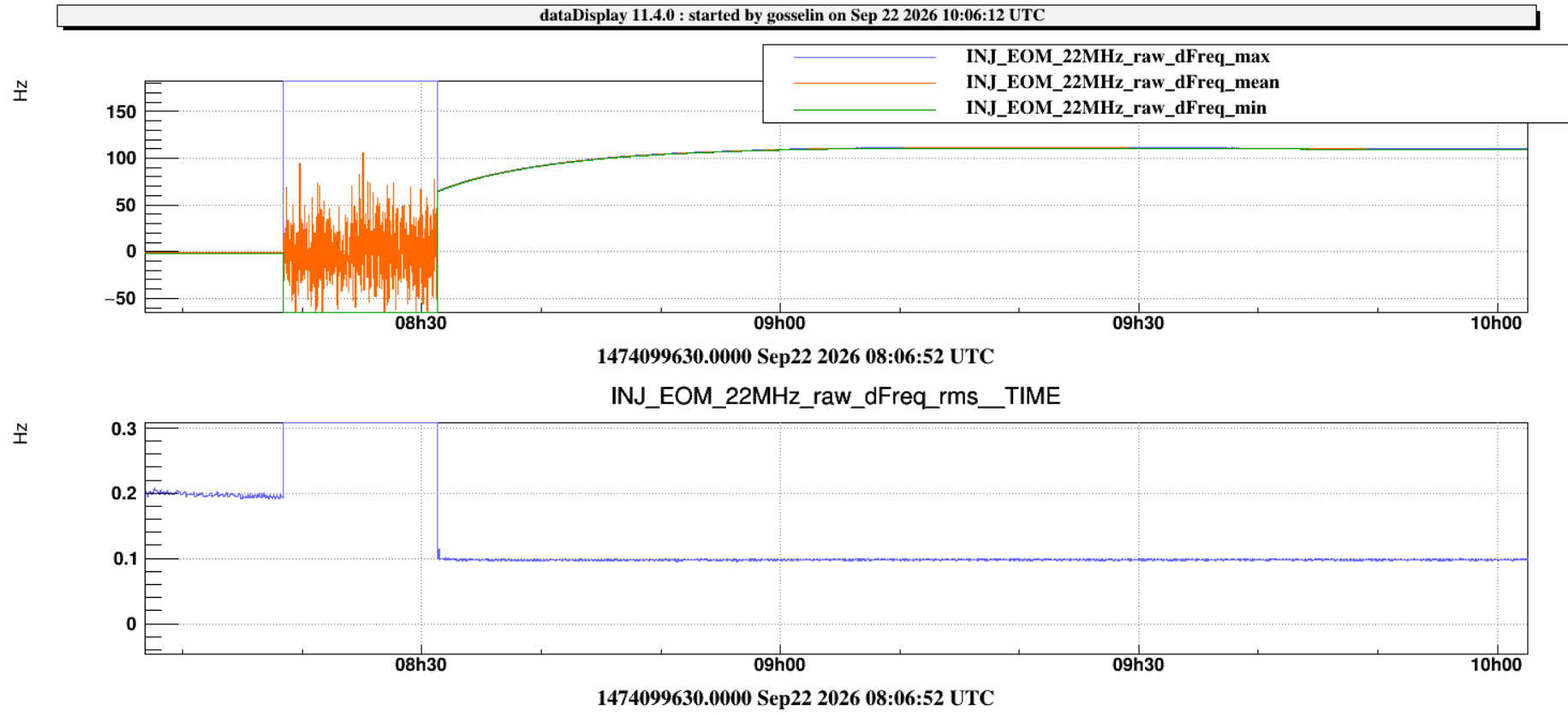
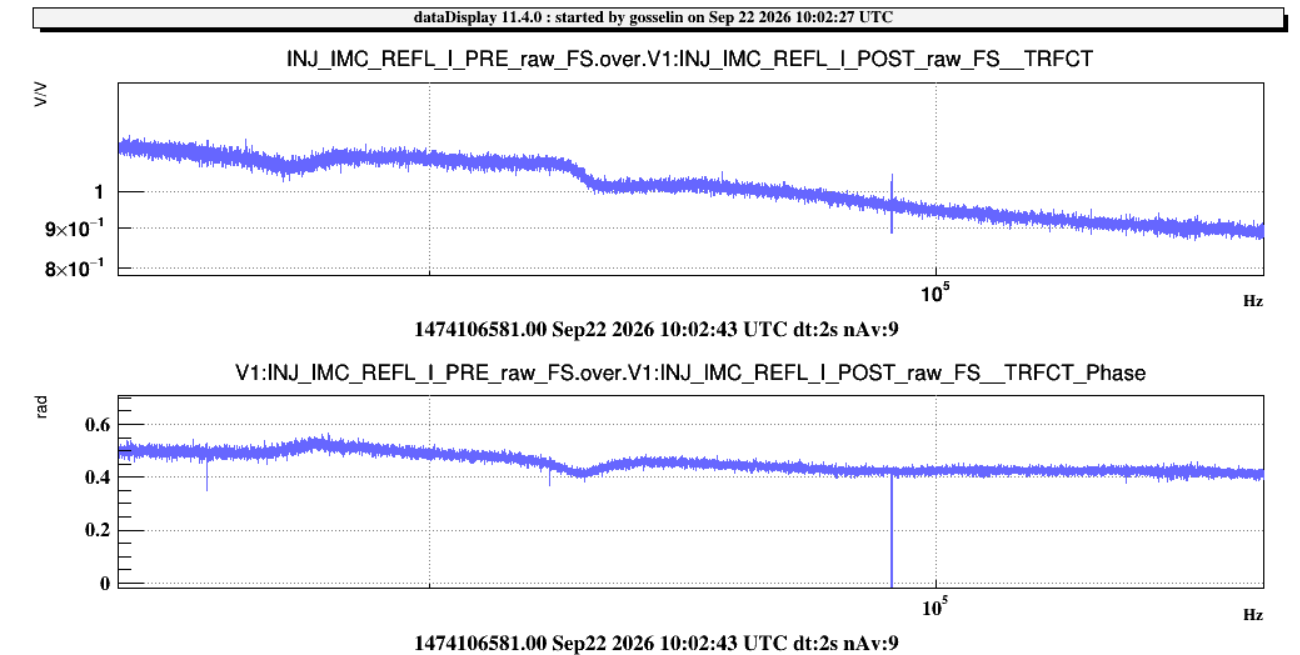
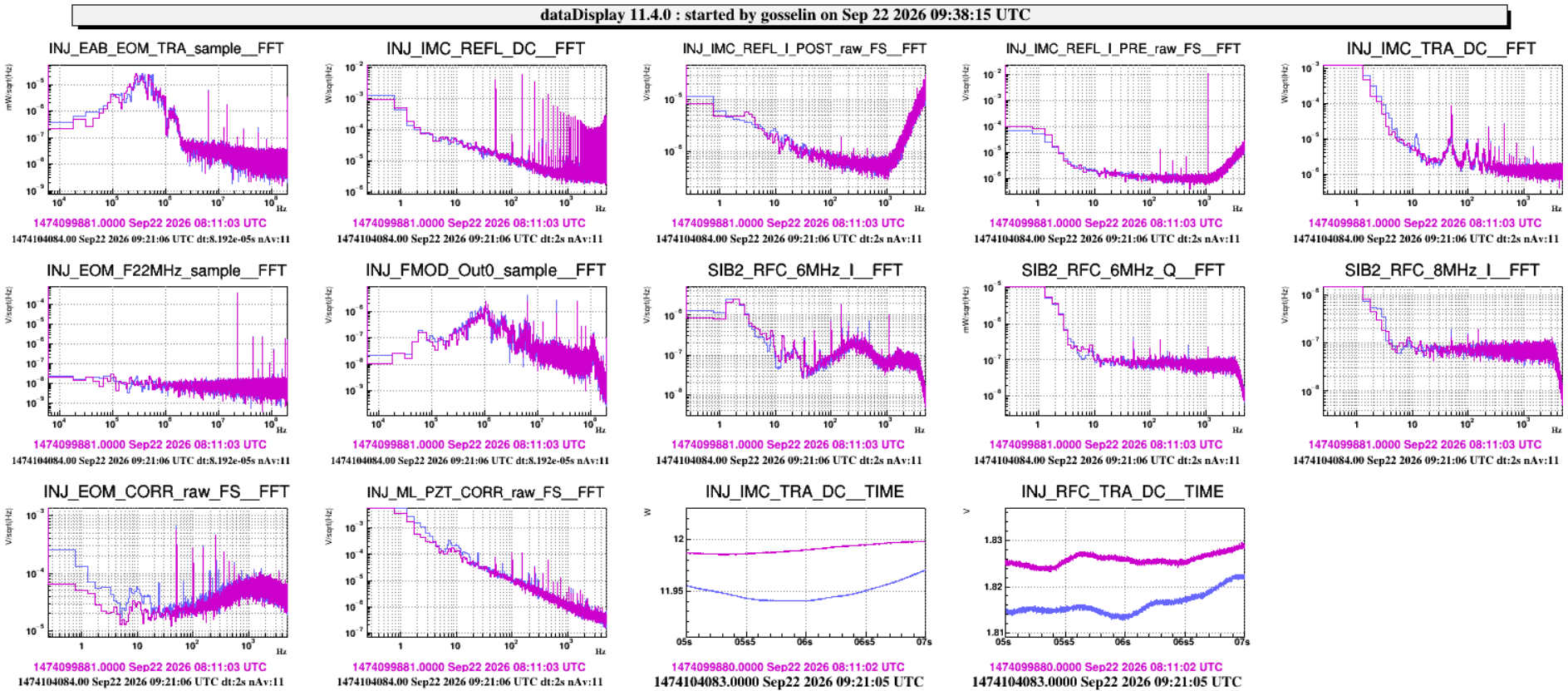
We checked some INJ signals : IMC and RFC error signals, 22 dfreq, IMC OLTF... and everything seems to be ok (figures attached)
To attempt to help with COMMp, yesterday at 14h53 UTC I have increased the SNEB drift control loop gain by a factor 2. The loop error signal is power normalized, so this is not intended to compensate a loss of loop gain due to low power, but to actually increase the loop gain.
Another direction to explore is what is happening with PRCL.
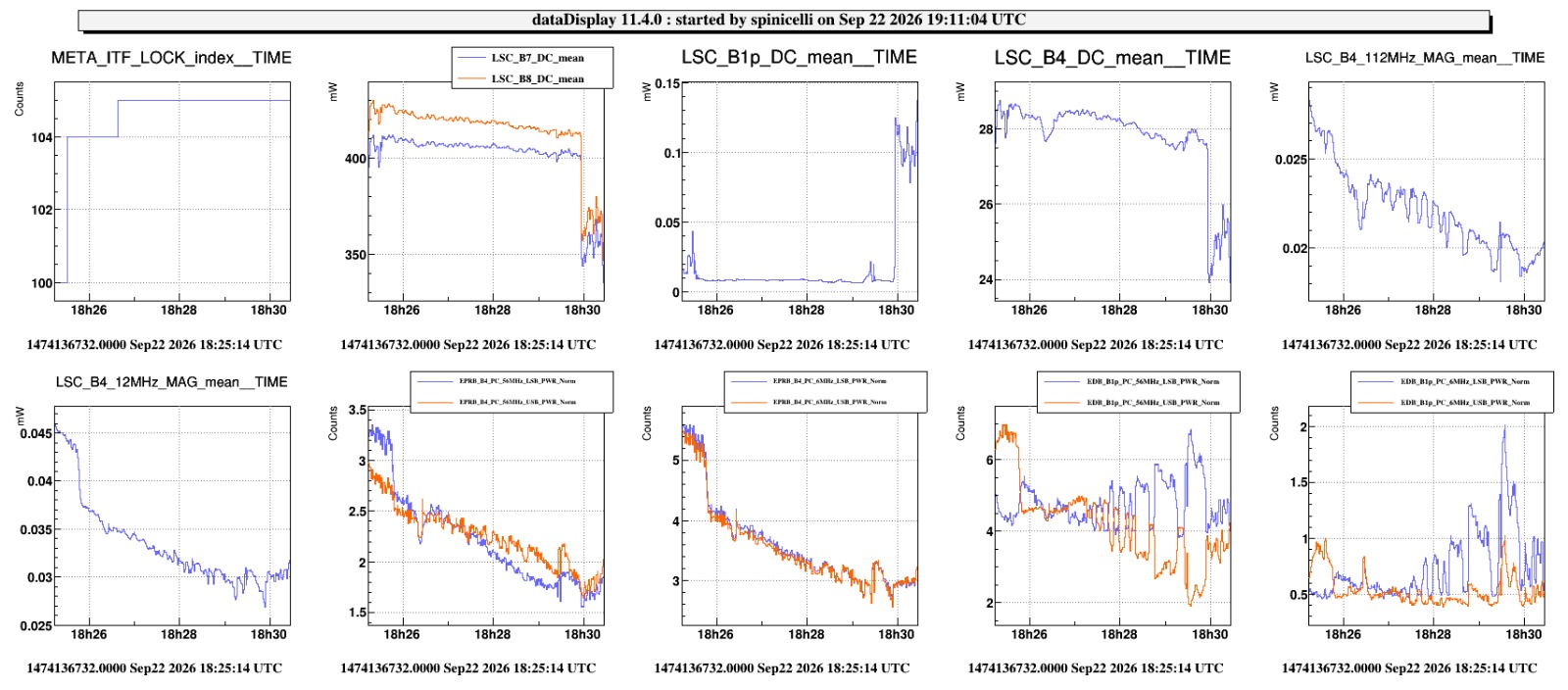
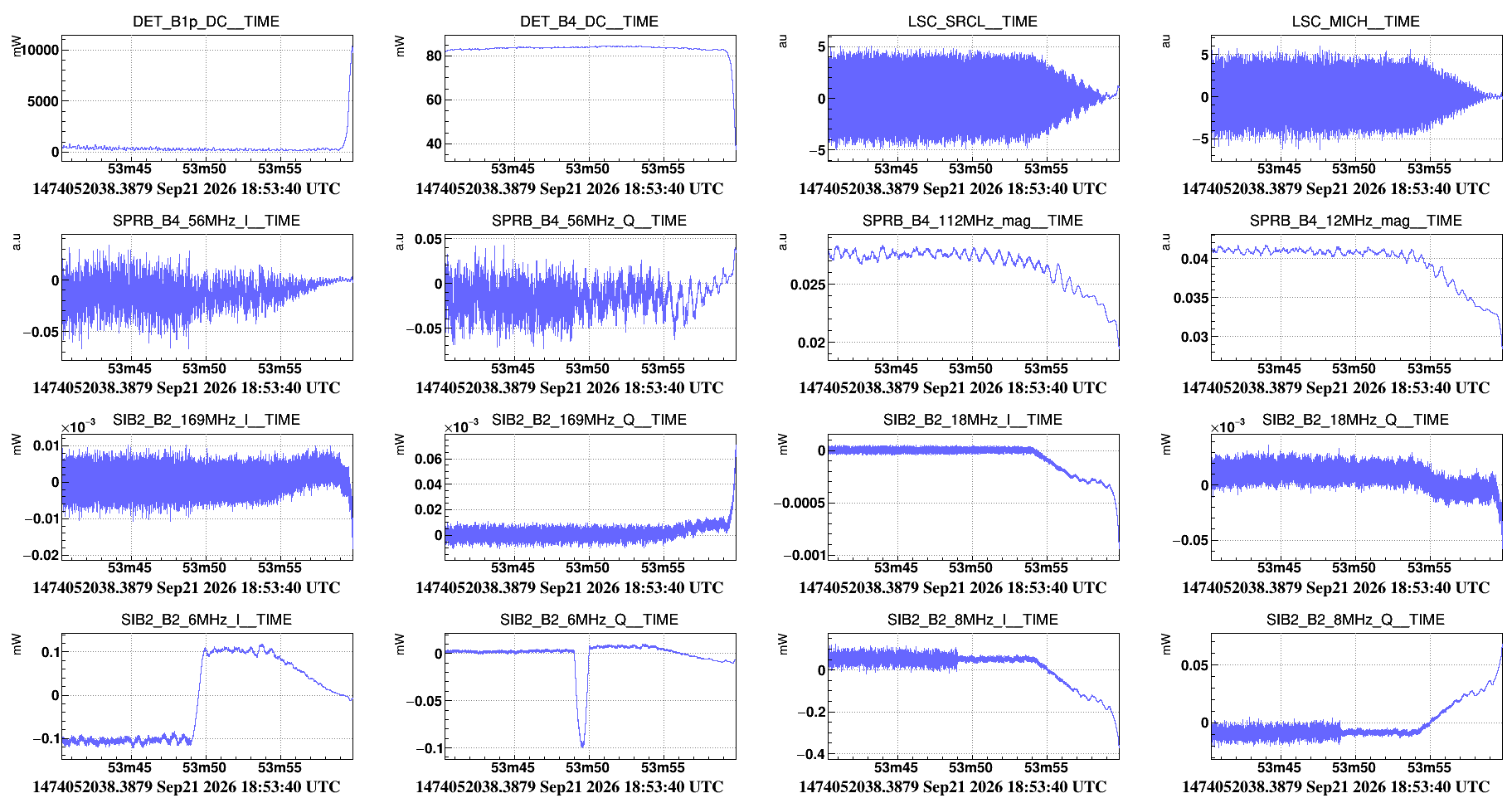
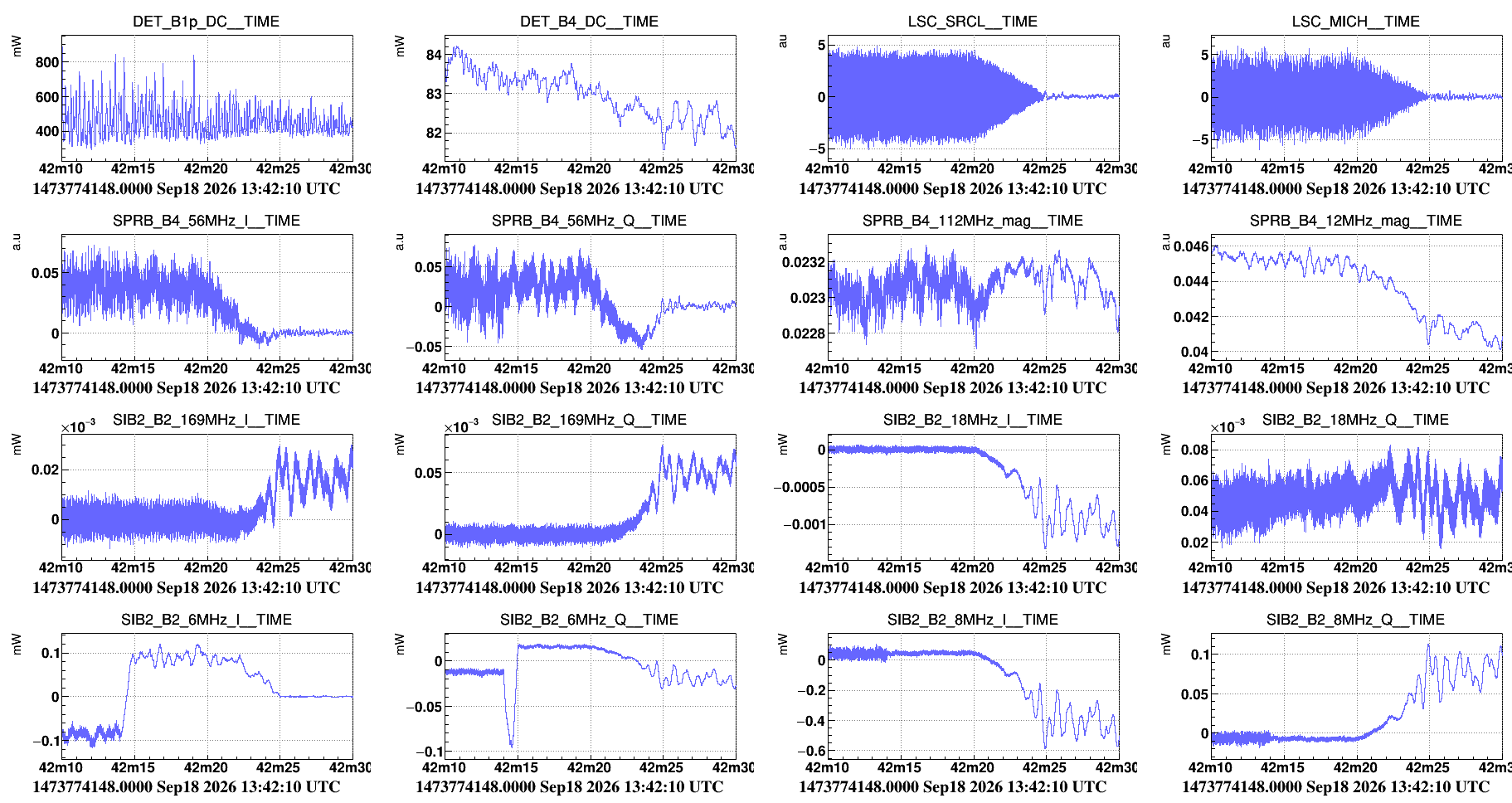
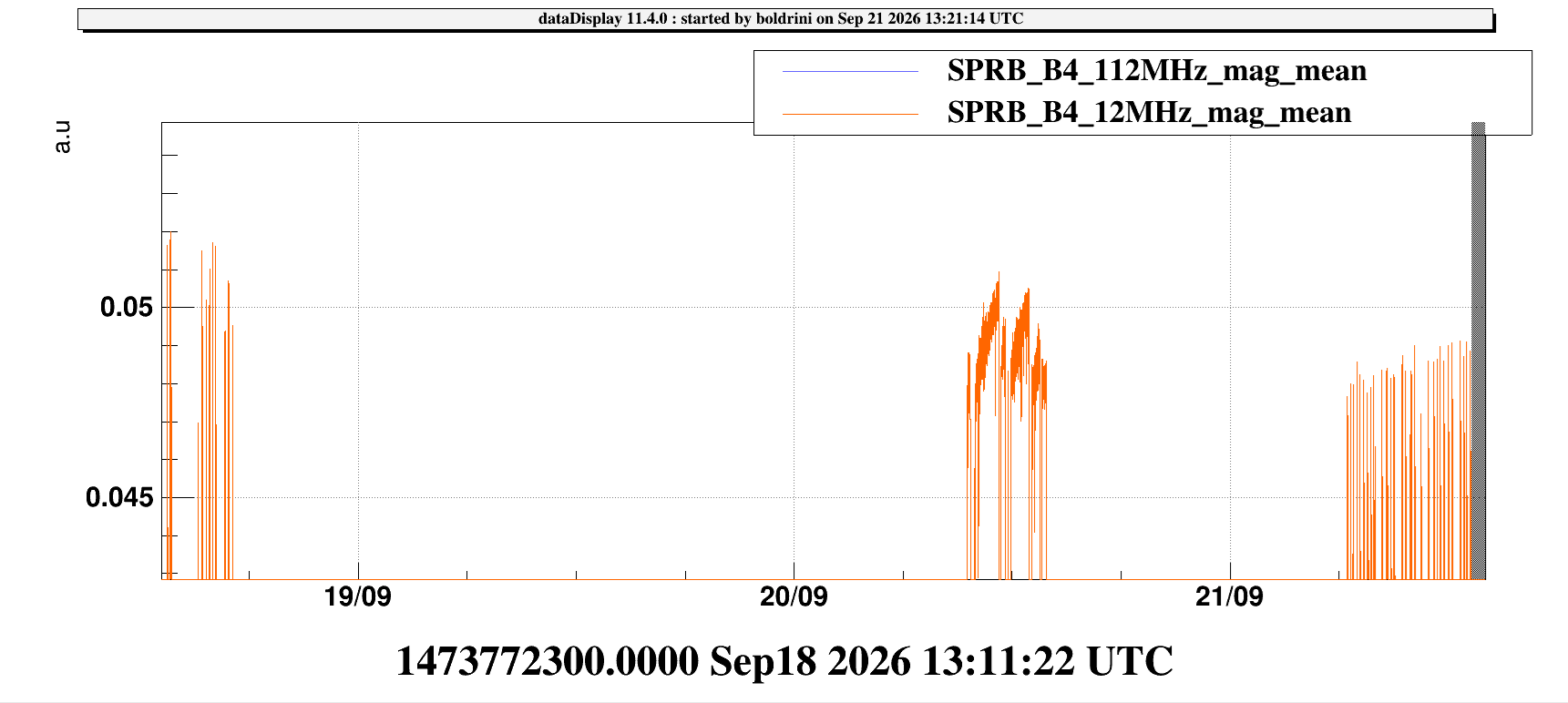
Figure 1 shows an example of an unlock of yesterday evening, B2 6MHz I is in loop for PRCL, but the out of loop signals B2 18MHz I and B2 8MHz I start to diverge at the same time as the power in the arm drops. B2 18MHz is independent of the carrier, so the drop in carrier power is not sufficient to explain the change in B2 18MHz I. There is also a sharp drop in B4 12MHz mag that starts at the same time, which is also independent from the carrier.
Figure 2 shows an example of a longer lock from last Friday, which shows that the offset on B2 6MHz I is comparable to what it used to be, and that the change in sign of the offset is just due to the adjustment of the demodulation phase of B2 6MHz before the signal is used. B2 18MHz and B2 8MHz have large fluctuation that start at that time, which makes the running away of these signals on Figure 1 less convincing. However, there is no simulataneous decrease in B4 12MHz mag in that case.
During the afternoon two activities went on: #69785 TCS tuning and #69787 CARM_NULL locking
Activities ended at 20:00 UTC
ITF left in LOCKED_ARMS_IR
In the afternoon shift we noticed a difficulty in locking the DRMI; once we could lock we checked the different steps, and yet again the MICH/SRCL demodulation phase had changed, especially for the 56MHz (and less so for the 169MHz); we checked a few things along the following steps:
Another direction to explore is what is happening with PRCL.
Figure 1 shows an example of an unlock of yesterday evening, B2 6MHz I is in loop for PRCL, but the out of loop signals B2 18MHz I and B2 8MHz I start to diverge at the same time as the power in the arm drops. B2 18MHz is independent of the carrier, so the drop in carrier power is not sufficient to explain the change in B2 18MHz I. There is also a sharp drop in B4 12MHz mag that starts at the same time, which is also independent from the carrier.
Figure 2 shows an example of a longer lock from last Friday, which shows that the offset on B2 6MHz I is comparable to what it used to be, and that the change in sign of the offset is just due to the adjustment of the demodulation phase of B2 6MHz before the signal is used. B2 18MHz and B2 8MHz have large fluctuation that start at that time, which makes the running away of these signals on Figure 1 less convincing. However, there is no simulataneous decrease in B4 12MHz mag in that case.
At around 13:30 UTC, we prepared the DET HWS measurement to sense the NI mirror: the INJ HWS beam was turned OFF and the DET HWS beam was set to 1.4V.
After various attempts of lock acquisition up to CARM NULL 1F, we agreed with the ISC team to perform a CH common step. Specifically, at 14:11 UTC both the CH powers have been increased by 20% (STEP 10), as detailed in the table below.
| STEP 10 | CH [W] | INNER DAS [W] | OUTER DAS [W] | |
| W | on the ITF | 0.044 → 0.053 | 0.120 | 1.296 |
| on the pickoff | 0.272 → 0.326 | 0.019 | 0.216 | |
| N | on the ITF | 0.040 → 0.048 | 0.216 | 0.864 |
| on the pickoff | 0.247 → 0.296 | 0.035 | 0.142 |
No sufficiently long locks have occurred to allow a measurement with the HWS DET, so the activity will be postponed to the upcoming shifts.
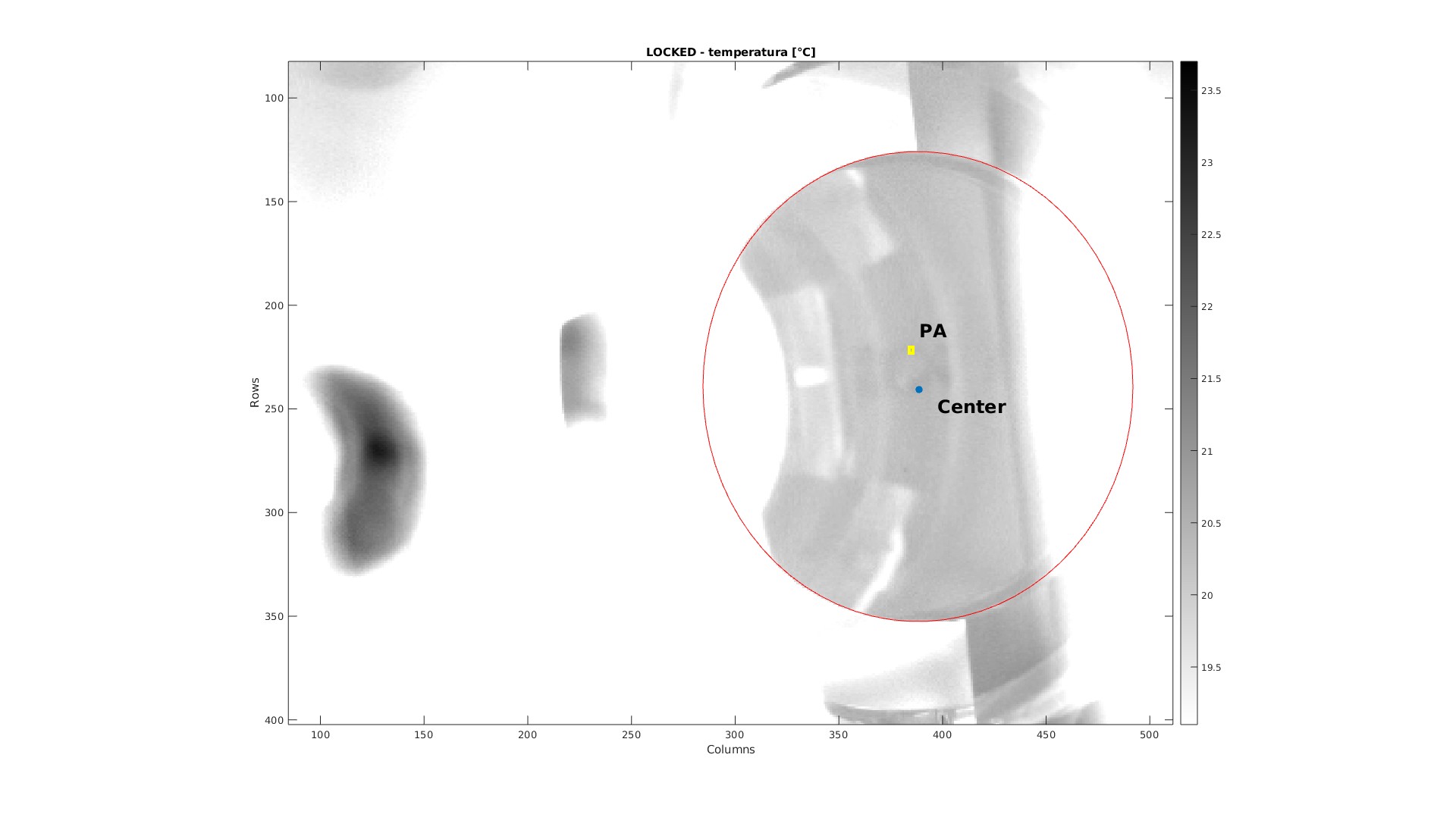
Today, an analysis of the WI point absorber was performed using thermocamera images.
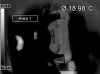
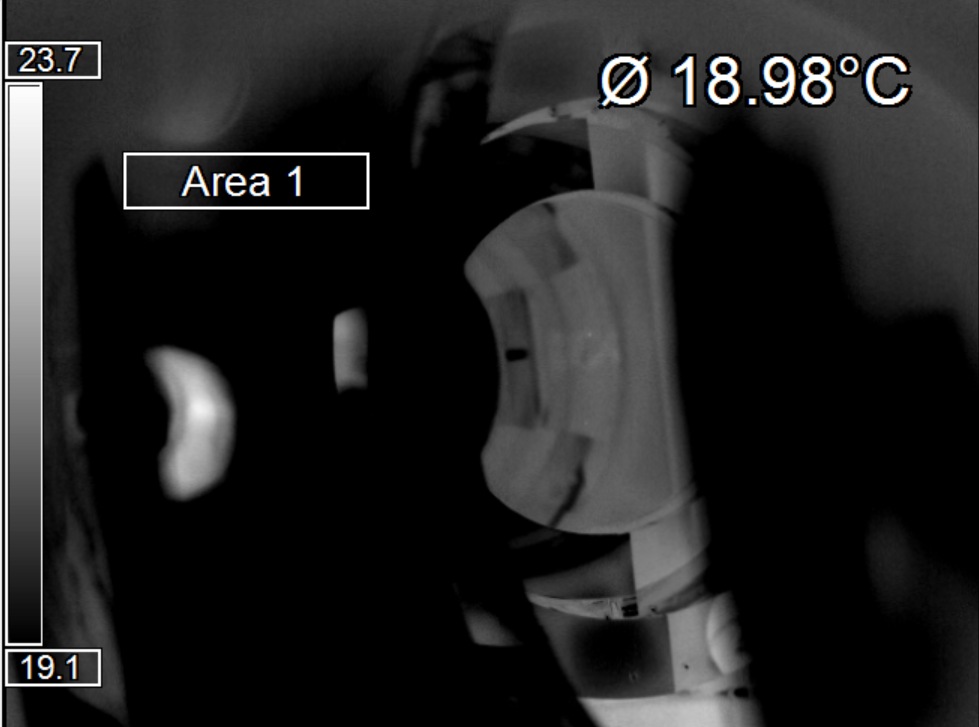
Fig. 1 shows the reference thermal image selected for the analysis.
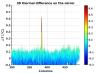
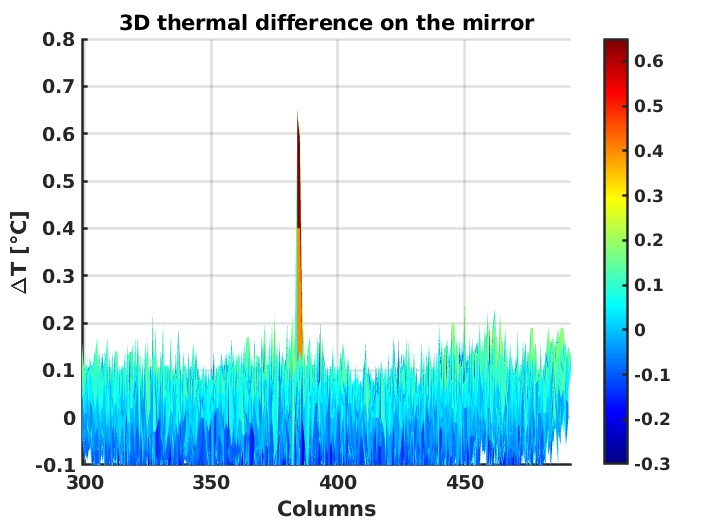
Fig. 2 displays the MATLAB analysis output, highlighting a differential temperature of approximately 0.65 degrees for the point absorber (calculated by subtracting the mirror image in CARM_NULL from the image taken with the ITF in DOWN status).
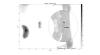
Fig. 3 illustrates the reconstructed mirror geometry, featuring the identified mirror center and the point absorber location based on pixel-to-distance mapping.
Geometric Mapping:
X-Axis (Columns): The mirror center is located at column 388, whereas the point absorber is at column 384. This places the point absorber slightly to the left of the center (a offset of 3.5 pixels in the image, corresponding to approximately 0.5 cm in physical space).
Y-Axis (Rows): The mirror center is located at row 241, whereas the point absorber is at row 221. This places the point absorber above the center (an offset of 19.5 pixels in the image, corresponding to approximately 3.0 cm in physical space).
Radial Distance: The total estimated physical distance of the point absorber from the mirror center is approximately 3.1 cm.
Note that because this spatial mapping is reconstructed manually from off-axis thermocamera images, it is subject to geometric projection and pixel-resolution uncertainties. Consequently, this estimate should be considered less precise than the HWS measurement and serves primarily as a qualitative/cross-checking reference.
I will soon perform a similar analysis of the NI PAs.
Today we attempted to recover the lock acquisition after this Sunday's DAS step.
We noticed that sidebands power has decreased at the DRMI step (Fig.1), but despite this the lock acquisition is somewhat workable without the need of any major change, although it tends to fail in STEP_3_OF_3 for reasons unclear.
The lock in CARM_NULL_1F is achievable, but not particularly stable. We noticed that a frequent cause of unlock is COMMp, who attempts to engage far away from its working point, possibly due to a slight misalignment of the SNEB that introduces a large DC offset in the error signal. For the moment, COMMp and the soft loops have been commented in ITF_LOCK.py (lines 4544-4545 for COMMp and 4458-4461 for soft modes)
To attempt to help with COMMp, yesterday at 14h53 UTC I have increased the SNEB drift control loop gain by a factor 2. The loop error signal is power normalized, so this is not intended to compensate a loss of loop gain due to low power, but to actually increase the loop gain.
ITF found in LOCKED_ARMS_IR in COMMISSIONING mode.
Locking in progress up to CARM_NULL_1F after the usual cross-alignment in ACQUIRE_DRMI.
Planned activity:
CARM NULL locking / DAS adjustment (Boldrini)
DET
Both SDB2_B1p_QD1 and SDB2_B1p_QD2 VBias' rearmed and shutter opened several times during the locking attempts.
The following report has been submitted to the On-call interface.
On-call events -> Air Conditioning
Title: Compressore d'aria n. 2 TB in blocco
Author(s): soldani, Pezzimenti
| Called at: , , by: Alarm or monitoring system |
| Remote intervention: Started: ; Ended: |
| On-site intervention: Started: 07:41, 20-09-2026; Ended: 07:56, 20-09-2026 |
| Status: Resolved |
| Operator when issue resolved: None |
Details:
Allarme ricevuto sabato ore 21, sia da me che dal Reperibile HVAC in turno Marco Tacchi. Telefonicamente e con l'ausilio del DMS e' stato verificato che il compressore n. 2 in TB era in blocco ("mancata ripartenza") ma il n. 1 era correttamente funzionante e l'impianto non ha subito cali di pressione. E' stato deciso che un intervento immediato sul sito non era necessario.
Ho provveduto a ripristinare il funzionamento del compressore n. 2 alle 7:45 circa del mattino successivo (domenica 20/09).
* Note that any files attached to this report are available in the On-call interface.
The following report has been submitted to the On-call interface.
On-call events -> Air Conditioning
Title: Compressore d'aria n. 2 TB in blocco
Author(s): soldani, Pezzimenti
| Called at: , , by: Alarm or monitoring system |
| Remote intervention: Started: ; Ended: |
| On-site intervention: Started: 07:41, 20-09-2026; Ended: 07:56, 20-09-2026 |
| Status: Resolved |
| Operator when issue resolved: None |
Details:
Allarme ricevuto sabato ore 21, sia da me che dal Reperibile HVAC in turno F. Pezzimenti. Telefonicamente e con l'ausilio del DMS e' stato verificato che il compressore n. 2 in TB era in blocco ("mancata ripartenza") ma il n. 1 era correttamente funzionante e l'impianto non ha subito cali di pressione. E' stato deciso che un intervento immediato sul sito non era necessario.
Ho provveduto a ripristinare il funzionamento del compressore n. 2 alle 7:45 circa del mattino successivo (domenica 20/09).
* Note that any files attached to this report are available in the On-call interface.
The following report has been submitted to the On-call interface.
On-call events -> Air Conditioning
Title: Compressore d'aria n. 2 TB in blocco
Author(s): soldani, Pezzimenti
| Called at: , , by: Alarm or monitoring system |
| Remote intervention: Started: ; Ended: |
| On-site intervention: Started: 07:41, 20-09-2026; Ended: 07:56, 20-09-2026 |
| Status: Resolved |
| Operator when issue resolved: None |
Details:
Allarme ricevuto sabato ore 21, sia da me che dal Reperibile HVAC in turno F. Pezzimenti. Telefonicamente e con l'ausilio del DMS e' stato verificato che il compressore n. 2 in TB era in blocco ("mancata ripartenza") ma il n. 1 era correttamente funzionante e l'impianto non ha subito cali di pressione. E' stato deciso che un intervento immediato sul sito non era necessario.
Ho provveduto a ripristinare il funzionamento del compressore n. 2 alle 7:45 circa del mattino successivo (domenica 20/09).
* Note that any files attached to this report are available in the On-call interface.
As agreed during Friday's Daily Meeting, we increased the power of all DAS actuators by 20%.
I also switched ON the WI inner ring, which had remained OFF so far, setting it to the minimum power of 120 mW.
The powers corresponding to this new configuration (STEP 10) are summarized in the table below:
|
| STEP 10 | CH [W] | INNER DAS [W] | OUTER DAS [W] |
| W | on the ITF | 0.044 | 0.120 | 1.296 |
| on the pickoff | 0.272 | 0.019 | 0.180*(1+20%)=0.216 | |
| N | on the ITF | 0.040 | 0.216 | 0.864 |
| on the pickoff | 0.247 | 0.029*(1+20%)=0.035 | 0.118*(1+20%)=0.142 |
The activity was completed at 09:11 UTC. In order to follow the transient, I asked to keep the CITF locked. Then, just as a test, we attempted a lock acquisition up to CARM NULL. The interferometer remained in CARM NULL for a few minutes before unlocking. I left the ITF locked in CITF. Later in the afternoon, I will request Locked Arms on IR.
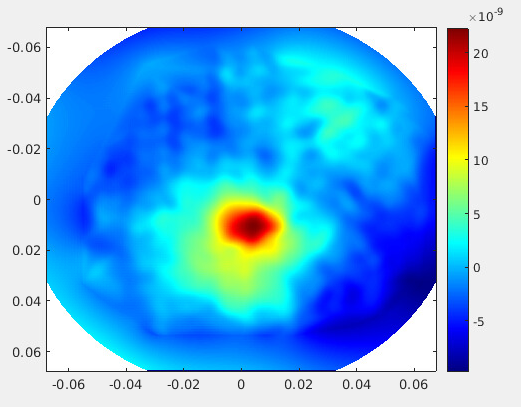
These results are so far qualitevely similar to the point absorbers measurements done at LMA VIR-0406A-26.
For WI the LMA measurements had shown one strong point absorber close to the center (-10mm, +24mm) with an expected absorbtion of 7-8mW for 100kW of power in the arms. It was point 5012 of the input mirror scan.
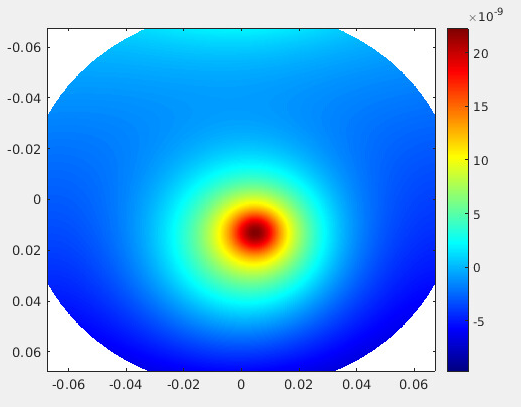
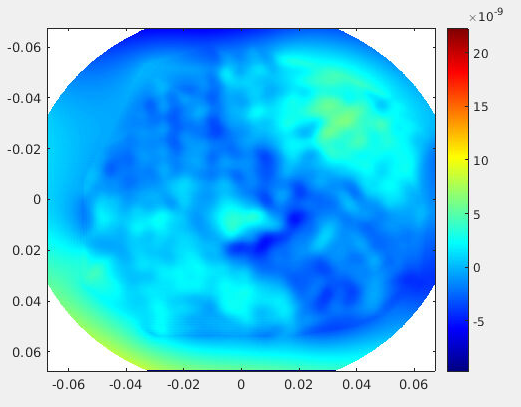
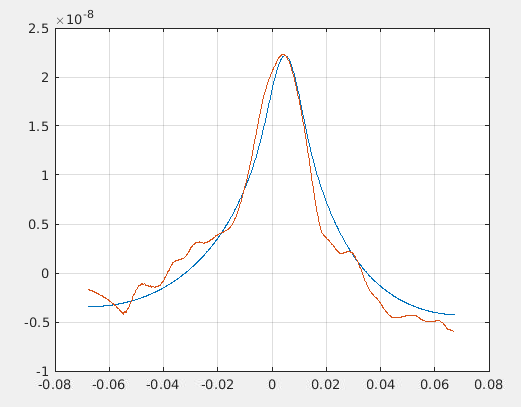
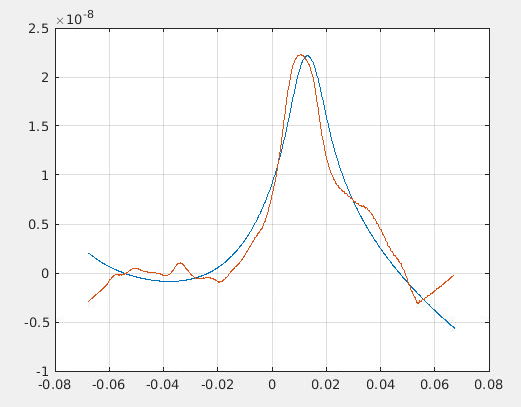
Analyzing the HWS image from yesterday with the same type of code as the LMA measurements I find that to make a comparable effect to what is on the HWS image, an absorption of 11mW is needed. The power in the arms is currentlny around 80kW, so scaling it to 100kW it correspond to an absorption of 14mW, almost double what was expected.
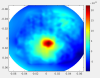
Figure 1 shows the HWS image after 10 wavefronts, roughly 5 minutes.
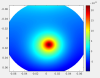
Figure 2 shows the model of the HWS image after 5 minutes for one point absorber and uniform absorption of 20mW.
Figure 3 shows the difference between the HWS image and the model
Figure 4 and 5 shows vertical and horizontal cuts through the HWS image and the model
/users/mwas/TCS/HWS_image_convolution/image_convolution_WI_IM01_transient.m
For NI several point absorbers with lower absorption are expected from the LMA measurement. Which qualitely is what is seen on the NI thermal camera image, where the points look much less bright than on the WI thermal camera image. A HWS image of NI would be needed to confirm that indeed the NI point absorbers have a lower absorption than the WI point.
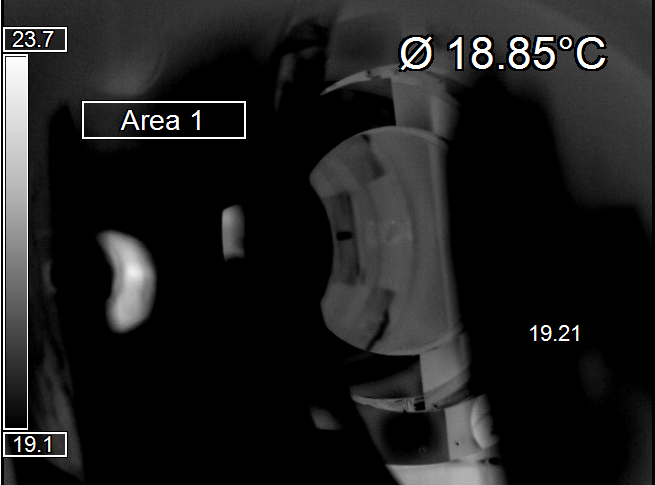
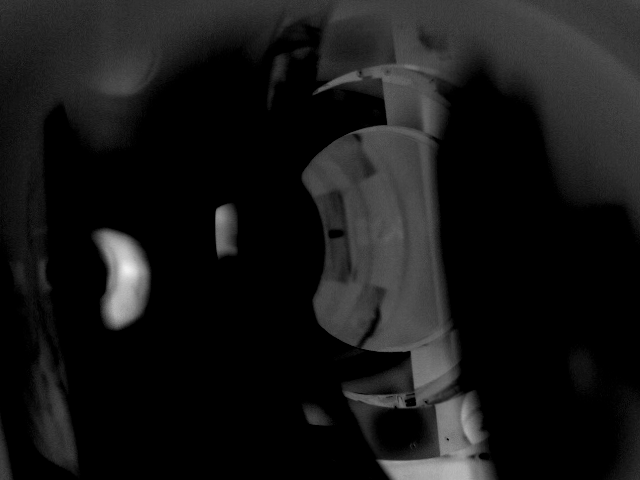
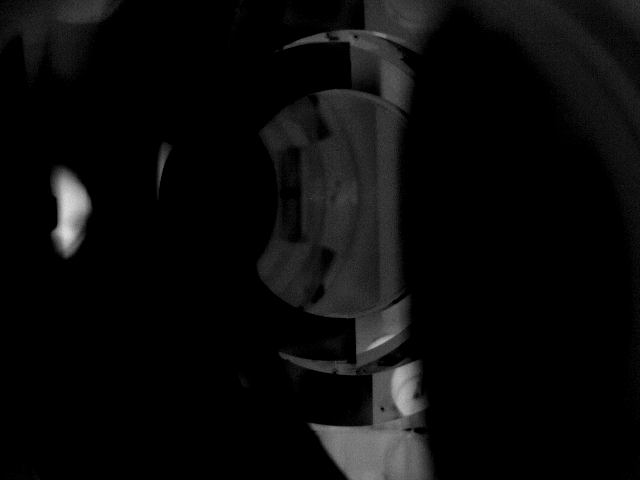
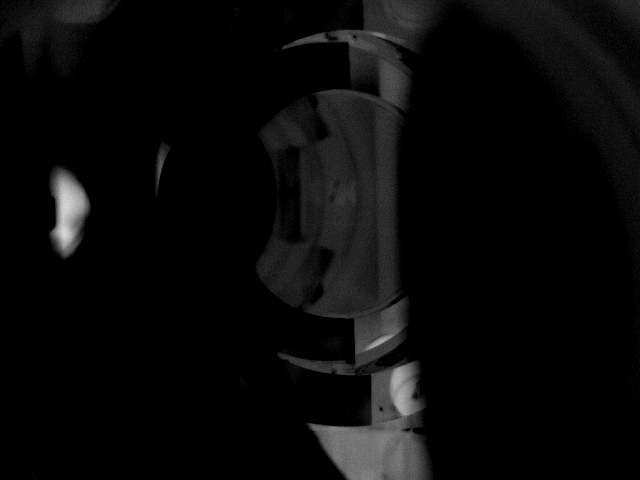
In the afternoon, the lock acquisition worked smoothly. Thus, I took some time to check the focus of the NI and WI thermocamera. In addition I also tried to focus the PAY NI Cam.
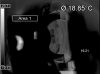
I could look at the camera images during several lock acquisitions, and those seem to confirm the presence of the WI PA (Fig. 1 and the down in fig 2, tiff and csv data on demand). Unfortunately, also the NI mirror seems to have some points (a clear one on the left part of the image and a fainter one on its right) that shine up with the lock acquisition (fig. 3 and the donw in fig. 4, tiff and csv data on demand).
To be confirmed with further HWS absorption measurements.
In both cases, they start to shine already at step 3/3 (250mW).
I left the ITF locked on the arms for the weekend.
Yesterday evening we raised the WI CH power (STEP 5, around +40%) in an attempt to set the SBs level in CITF back to their maximum values, i.e. around 0.054 mW for the 6 MHz and 0.032 mW for the 56MHz. So the starting point of this morning is summarised in the table below:
| Starting Point | CH [W] | INNER DAS [W] | OUTER DAS [W] |
|---|---|---|---|
| on the ITF | 0.044 | 0 | 1.08 |
| on the pickoff | 0.272 | 0 | 0.180 |
| on the ITF | 0.031 | 0.18 | 0.72 |
| on the pickoff | 0.192 | 0.029 | 0.118 |
Also this morning we made a further action, this time on the NI CH; we performed two steps:
STEP 6, NI CH power +18%, at 7.23 UTC
Since STEP 7 decreased the 12 MHz signal, we partially reverted the change by 9% with respect to STEP 7.
After these two steps, we resumed the lock acquisition attempts up to CARM NULL. After several attempts, which consistently unlocked at the same stage of the lock acquisition, the ISC team solved the issue by adjusting some lock acquisition parameters.
At 08:31 UTC, CARM_NULL_1F was reached and the lock lasted for about 30 minutes.
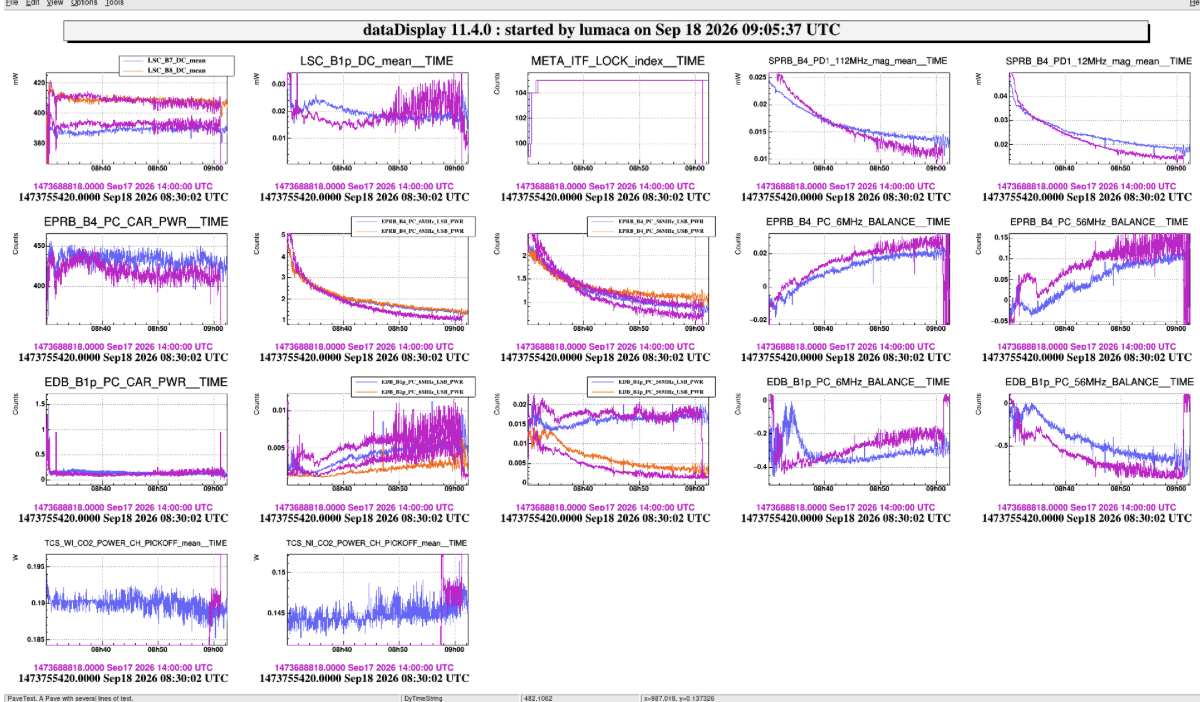
Figure 1 shows a comparison between this CARM_NULL_1F lock (08:31 UTC, lasting about 30 min, blue and orange lines) and the one obtained yesterday (17/09 at 14:14 UTC, lasting about 25 min, purple lines). The DAS STEP3 improved the sideband level, as can be seen from the comparison.
After the 08:31 UTC lock, we were not able to lock again due to a vertical oscillation of the PR mirror at around 11 Hz, similar to the one observed yesterday (69770). We therefore called Paolo for support.
At 10:38 UTC, following Paolo's indications, Diego managed to reach CARM_NULL_1F again.
From this point on, the CARM_NULL_1F lock became reasonably reproducible. Thanks to Diego, we also recovered the automation for the gentle unlock. After a few trials, we were able to perform the planned HWS-INJ measurements, manually unlocking the interferometer when needed.
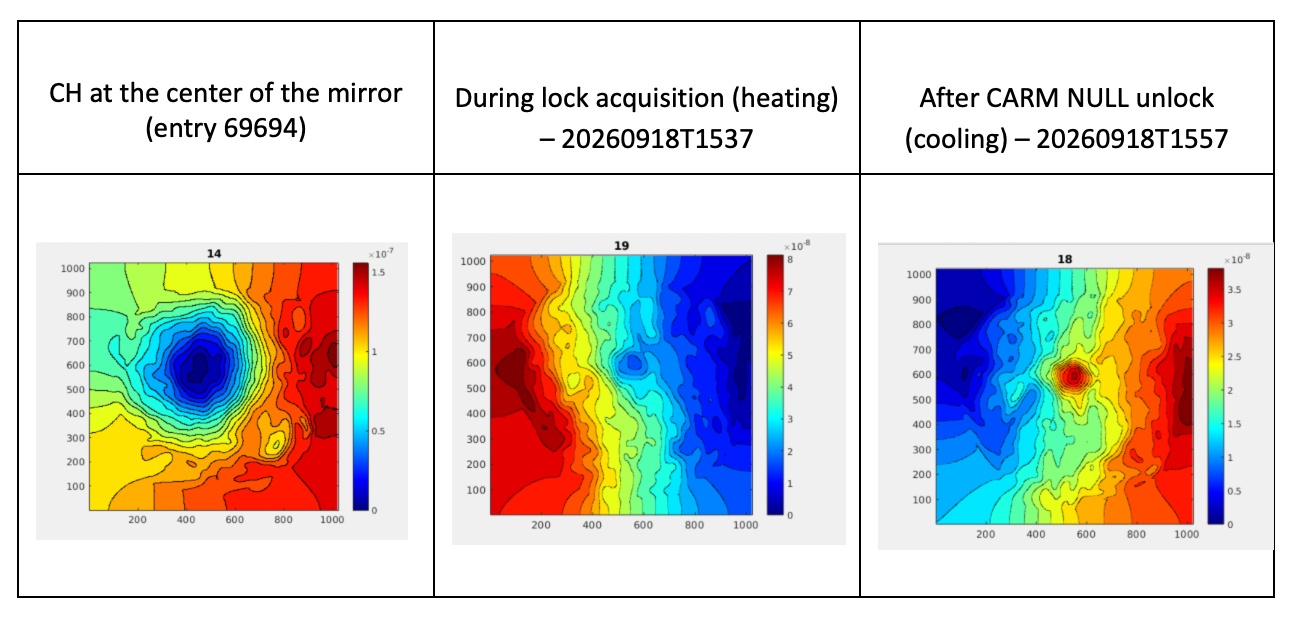
A PA signature is visible in the HWS-INJ maps in two different measurements: during the lock acquisition (heating phase) and after the unlock from CARM NULL (cooling phase), as shown in Fig. 2. In the same figure, the CH measurement reported in entry 69694 is shown as a reference for the mirror center. From this preliminary comparison, the PA appears to be reasonably close to the center of the mirror. A more detailed analysis of the acquired data will follow.
We left the following TCS settings:
|
|
| CH [W] | INNER DAS [W] | OUTER DAS [W] |
|---|---|---|---|---|
| W | on the ITF | 0.044 | 0 | 1.08 |
| on the pickoff | 0.272 | 0 | 0.180 | |
| N | on the ITF | 0.040 | 0.18 | 0.72 |
| on the pickoff | 0.247 | 0.029 | 0.118 |
In the afternoon, the lock acquisition worked smoothly. Thus, I took some time to check the focus of the NI and WI thermocamera. In addition I also tried to focus the PAY NI Cam.
I could look at the camera images during several lock acquisitions, and those seem to confirm the presence of the WI PA (Fig. 1 and the down in fig 2, tiff and csv data on demand). Unfortunately, also the NI mirror seems to have some points (a clear one on the left part of the image and a fainter one on its right) that shine up with the lock acquisition (fig. 3 and the donw in fig. 4, tiff and csv data on demand).
To be confirmed with further HWS absorption measurements.
In both cases, they start to shine already at step 3/3 (250mW).
I left the ITF locked on the arms for the weekend.
These results are so far qualitevely similar to the point absorbers measurements done at LMA VIR-0406A-26.
For WI the LMA measurements had shown one strong point absorber close to the center (-10mm, +24mm) with an expected absorbtion of 7-8mW for 100kW of power in the arms. It was point 5012 of the input mirror scan.
Analyzing the HWS image from yesterday with the same type of code as the LMA measurements I find that to make a comparable effect to what is on the HWS image, an absorption of 11mW is needed. The power in the arms is currentlny around 80kW, so scaling it to 100kW it correspond to an absorption of 14mW, almost double what was expected.
Figure 1 shows the HWS image after 10 wavefronts, roughly 5 minutes.
Figure 2 shows the model of the HWS image after 5 minutes for one point absorber and uniform absorption of 20mW.
Figure 3 shows the difference between the HWS image and the model
Figure 4 and 5 shows vertical and horizontal cuts through the HWS image and the model
/users/mwas/TCS/HWS_image_convolution/image_convolution_WI_IM01_transient.m
For NI several point absorbers with lower absorption are expected from the LMA measurement. Which qualitely is what is seen on the NI thermal camera image, where the points look much less bright than on the WI thermal camera image. A HWS image of NI would be needed to confirm that indeed the NI point absorbers have a lower absorption than the WI point.
Today, an analysis of the WI point absorber was performed using thermocamera images.
Fig. 1 shows the reference thermal image selected for the analysis.
Fig. 2 displays the MATLAB analysis output, highlighting a differential temperature of approximately 0.65 degrees for the point absorber (calculated by subtracting the mirror image in CARM_NULL from the image taken with the ITF in DOWN status).
Fig. 3 illustrates the reconstructed mirror geometry, featuring the identified mirror center and the point absorber location based on pixel-to-distance mapping.
Geometric Mapping:
X-Axis (Columns): The mirror center is located at column 388, whereas the point absorber is at column 384. This places the point absorber slightly to the left of the center (a offset of 3.5 pixels in the image, corresponding to approximately 0.5 cm in physical space).
Y-Axis (Rows): The mirror center is located at row 241, whereas the point absorber is at row 221. This places the point absorber above the center (an offset of 19.5 pixels in the image, corresponding to approximately 3.0 cm in physical space).
Radial Distance: The total estimated physical distance of the point absorber from the mirror center is approximately 3.1 cm.
Note that because this spatial mapping is reconstructed manually from off-axis thermocamera images, it is subject to geometric projection and pixel-resolution uncertainties. Consequently, this estimate should be considered less precise than the HWS measurement and serves primarily as a qualitative/cross-checking reference.
I will soon perform a similar analysis of the NI PAs.
Today around 15:12 UTC we changed the etalon setpoints: