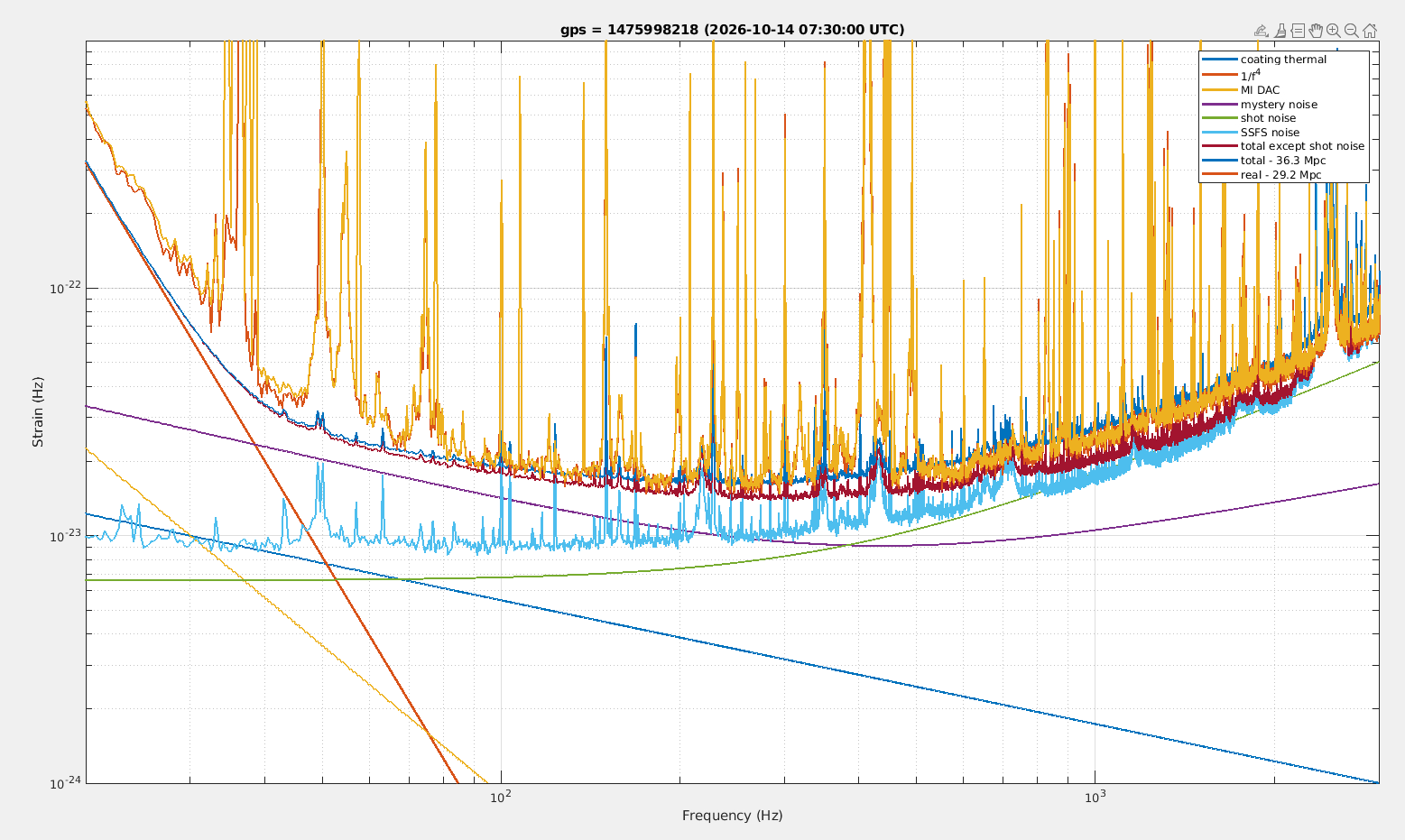
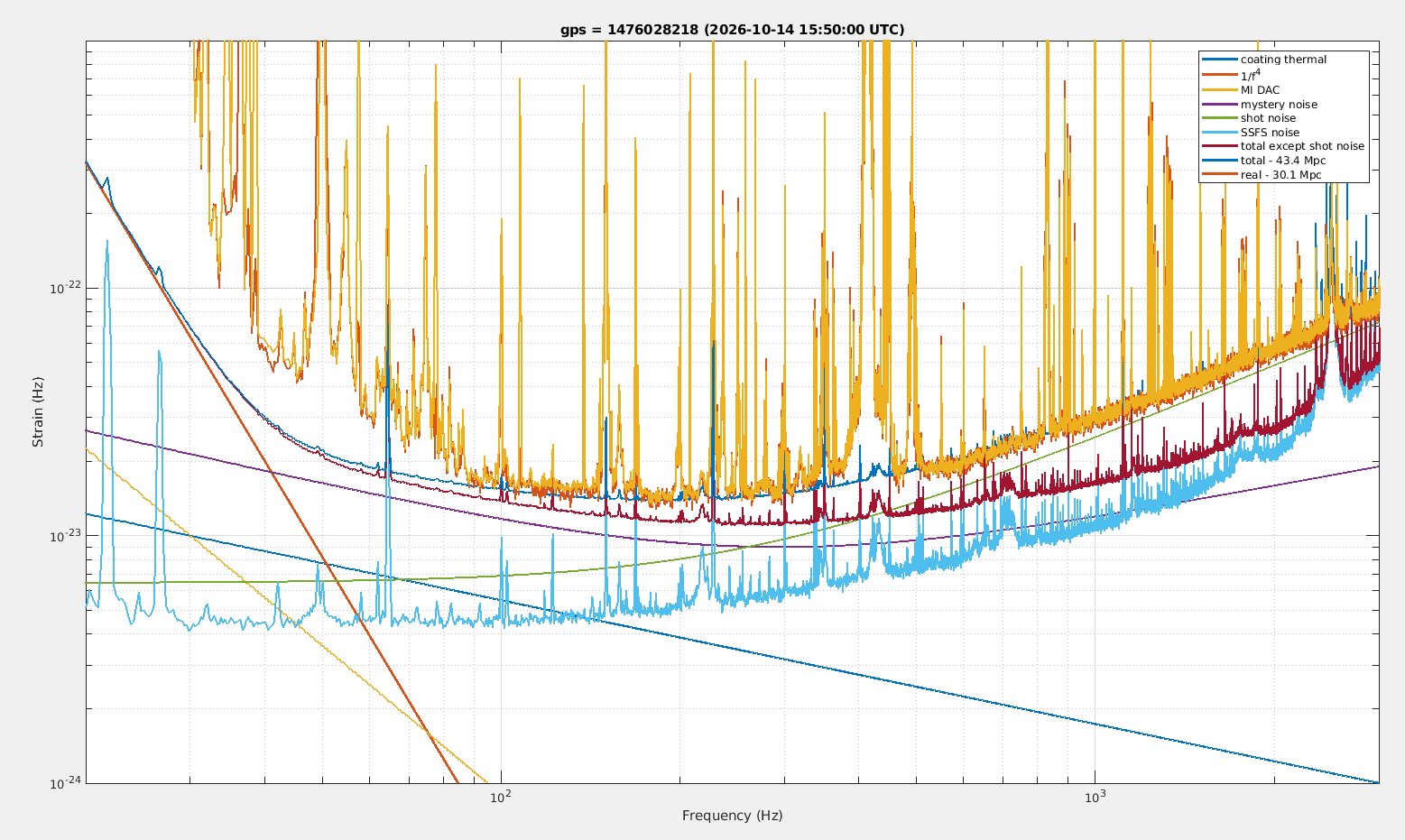
The morning shift started by relocking the interferometer, which had no issue on that front for the whole shift.
The idea of the shift was to start studying again the SRC longitudinal detuning. Before starting that, and also because we are now working decentering, a very basic set of angular noise injections was done (DIFFp, PR). The log file is in /virgoData/NoiseInjections/ASC/ASC_injection-1476000002.txt
After that, the tests on the SR detuning started; the first few tests were done naively by changing the setpoint of the SRCL_SET loop, which in the past did not give very good results, as the signal was not carrying enough information to drive it properly in the intended way (higher frequency for the optical spring). This happened in LOW_NOISE_3_ALIGNED.
Here the recap of the tests done in this way:
08:14:10 UTC : SRCL_SET_SET = 0.5 -> 5.0 in 300 s, then 480 s of clean data;
08:27:30 UTC : SRCL_SET_SET = 5.0 -> 10.0 in 300 s, then 600 s of clean data.
Around 8:31 UTC we observed some bursts of noise in the MICH loop (and, fainter, in the SRCL one) at around 3.6 Hz. Given that in that state the UGF servo loops are not operational anymore (with the exception of the DARM one), the gains of both of them were raised around 8:35:30 UTC. We unlocked at 8:38:52 UTC.
In the following lock, that started at 09:16:53 UTC:
09:27:42 UTC: SRCL_SET_SET = 0.5 -> 10.0 in 600 s
09:46:39 UTC: unlock
There were a couple of unattended tests during the lunch break, which look very similar and probably do not carry more information.
Later, we verifired offline from the tests that the OS signal moved back to a more manual approach: LOW_NOISE_2 state, SRCL_SET loop technically close but in reality frozen in place (LSC_SRCL_SET_CAL = 0), then LSC_SRCL_SET moved manually as a static offset.
Test #1:
12:29:00 UTC: start of LOW_NOISE_2
12:33:00 UTC: SRCL_SET loop frozen (value of _SET_TOT at the time ~ -8.3)
12:33:52 UTC: SRCL_SET = 0 -> -5 in 300 s
12:41:00 UTC: SRCL_SET = -5 -> -10 in 300 s
Noise injection on DARM (and clean data): logfile in /virgoData/NoiseInjections/LSC/LSC_injection-1476017575.txt
13:01 UTC: SRCL_SET = -10 -> -15 in 300 s
13:20 Noise injection on DARM (and clean data): logfile in /virgoData/NoiseInjections/LSC/LSC_injection-1476019008.txt
13:29:21 UTC: unlock
We continued to change the SRCL set at step LN2 (in order to have all the servo for the gains active) and we took :
- DARM OLTF measurements to fit the OS for different SRCL set
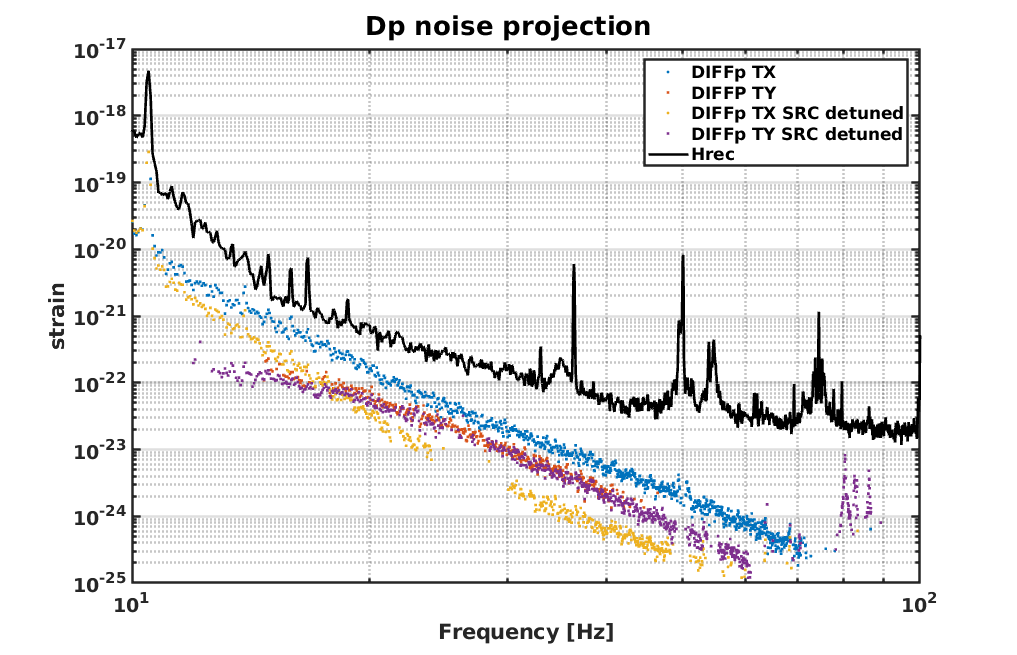
- Angular noise coupling (DIFFp) to see if the coupling could change with the SRCL set
the gps are:
SRCL set @ -10 gpsDARM=utc2gps(2026,10,14,14,32,45); dur DARM=120;
SRCL set @ -20 gpsDARM2=utc2gps(2026,10,14,14,47,50); dur DARM2=120;
gpsDptx=utc2gps(2026,10,14,14,57,00); dur Dptx=120;
gpsDpty=utc2gps(2026,10,14,15,04,10); dur Dpty=120;
It is visible that the -20 configuration shows a lower coupling of DIFFp TX (Figure 1)
After that we tried a SRCL set up to -30 but it failed the LN3 aligned state transition (a 3.5 Hz oscillation on MICH - most probably low gain, which is surprising since we let the servos to adjust the gain in the SRCL set increase and to stabilize).
We have then reached the LN3 aligned configuration and performed a SRCL detune to check the sensitivity (to be able to compare with the one that will be achieved with the diaphragm)