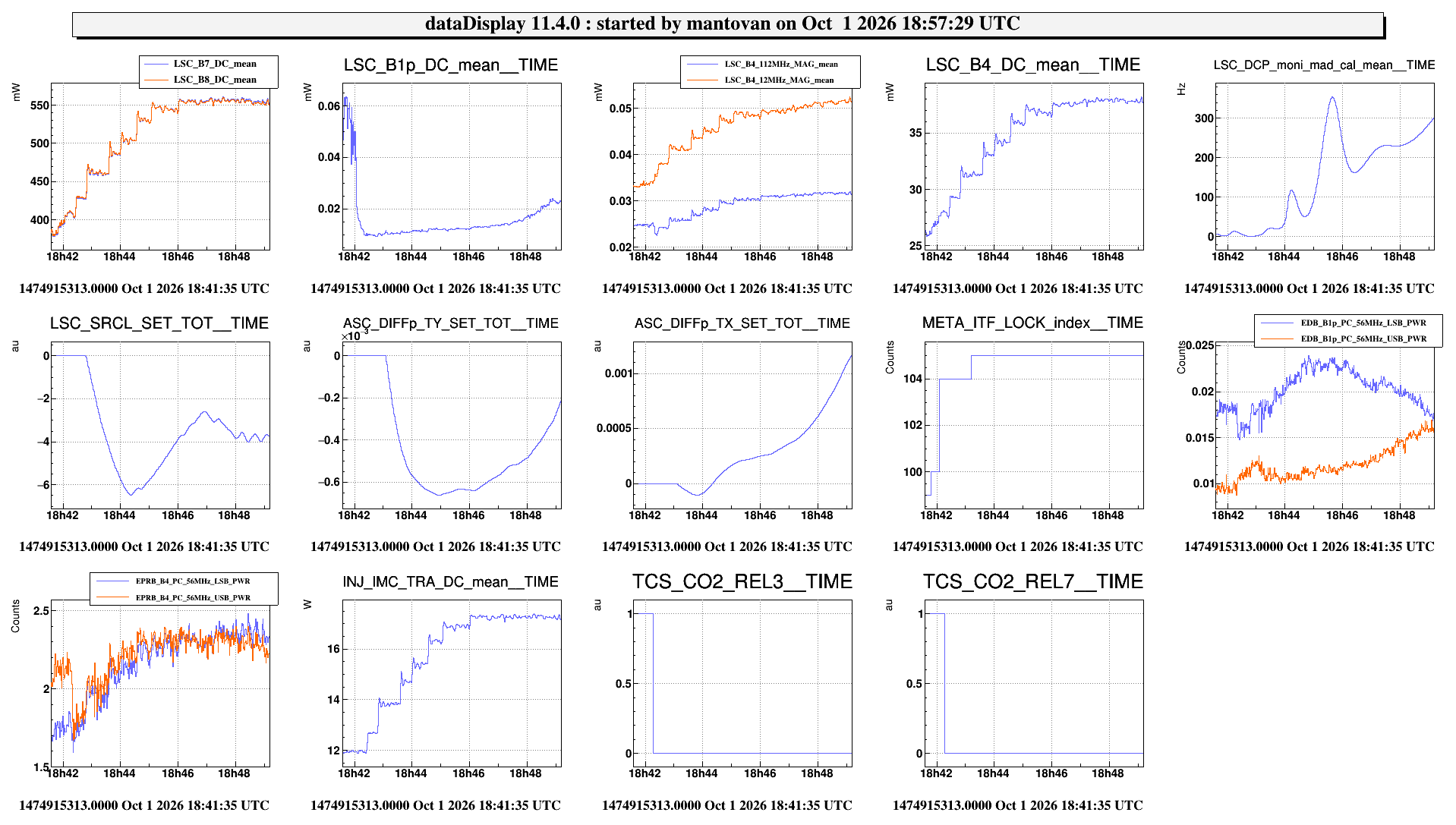
In order to support the TCS tuning of DAS for the final injection power of 18 W we changed online the transmission of the IMC from 11 W to 18 W while keeping a lock in CARM_NULL_1F.
The commands used are:
- to increase the input power:
- cm_send('EIBAgilisRot', 'MOVEREL', 1, 1, -2000, 50)
- to decrease the input power:
- cm_send('EIBAgilisRot', 'MOVEREL', 1, 1, 2000, 50)
- cm_send('EIBAgilisRot', 'MOVEREL', 1, 1, 2000, 50)
Where the '2000' is the step size not a setpoint. Note that the steps have some hysteresis, and coming back usually requires more step than going up in power.
Overall the DAS tuning is positive, with a well tuned common component that grants adequate sideband power but a less than optimal differential tuning that leaves a bright fringe of ~0.035 mW, against the 0.011 mW observed during O4.
The process of changing the power midlock was surprisingly easy, which gave us the idea of attempting a lock acquisition at low power. After tuning the CH to compensate for the new setpoint of the DAS, and increase again the power at CARM_NULL_1F, we modified the automation to close the flip mirrors of the CH at CARM_NULL_1F (before was at carm step 2/3), re-engaged the final working point with 11 W and then increased the power in steps to 17.3 W, starting when the flip mirrors close to roughly replace the CH with the YAG at the same time.
Against all expecations this worked very well, with the very appreciated advantage of avoiding the recovery of the whole lock acquisition and to ease the further TCS tuning.
This procedure can be stably adopted and be automated at least for the interferometer tuning phase.
Tomorrow this process will be automated, substituting the manual steps of the rotator on SIB1 with a servo loop.
We leave the ITF with arms locked, after restoring the transmission of the IMC to 11 W.