The stability and the duration of the lock in CARM NULL 1f has been studied for different positions of the resonant beam on the ITMs. Four conditions will be analysed in this entry:
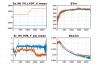
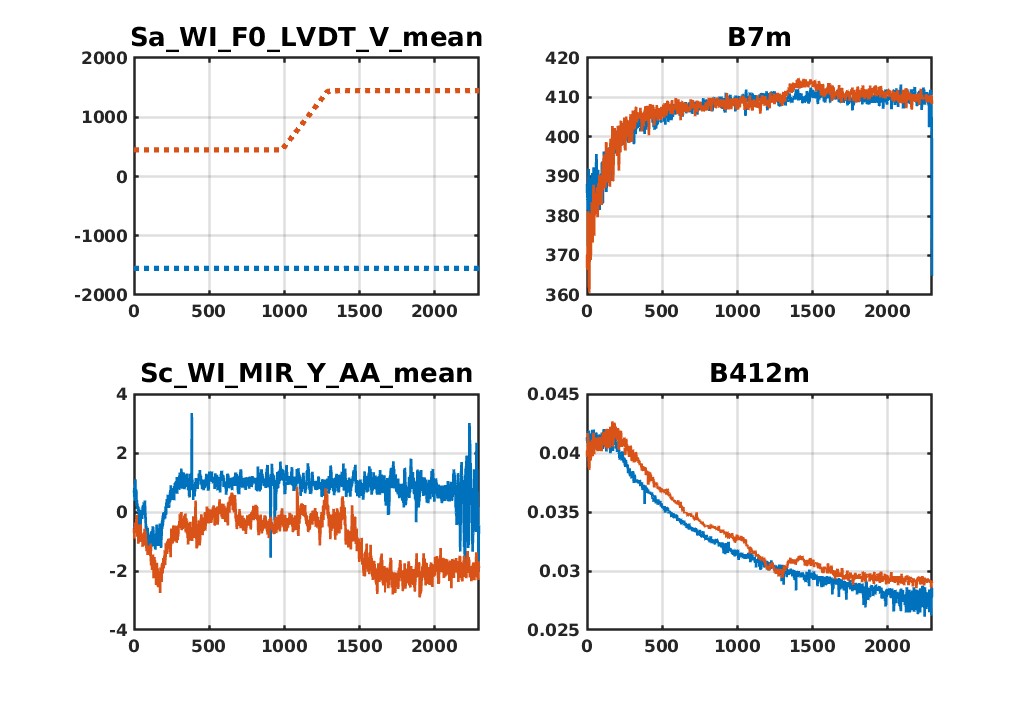
gps0=1474616480 --- standard working point. Lock acquired yesterday morning, before the beginning of the attivity. Unlock after 40 minutes, while the sidebands were low and the stability degradated.
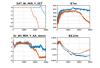
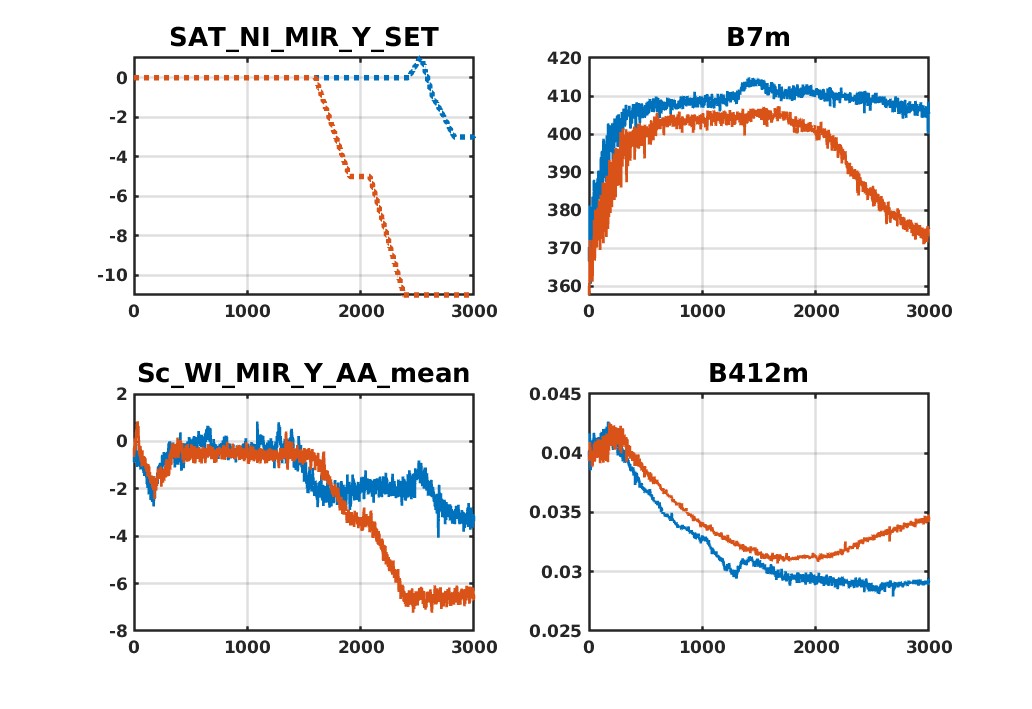
gps1=1474622079 --- the lock has been acquired with WI shifted upwards by ~ 2mm. The same shift was tested on friday during a lock, but this time the shift was performed before the lock. During this lock, the shift was increased by 1 mm more.
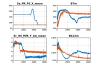
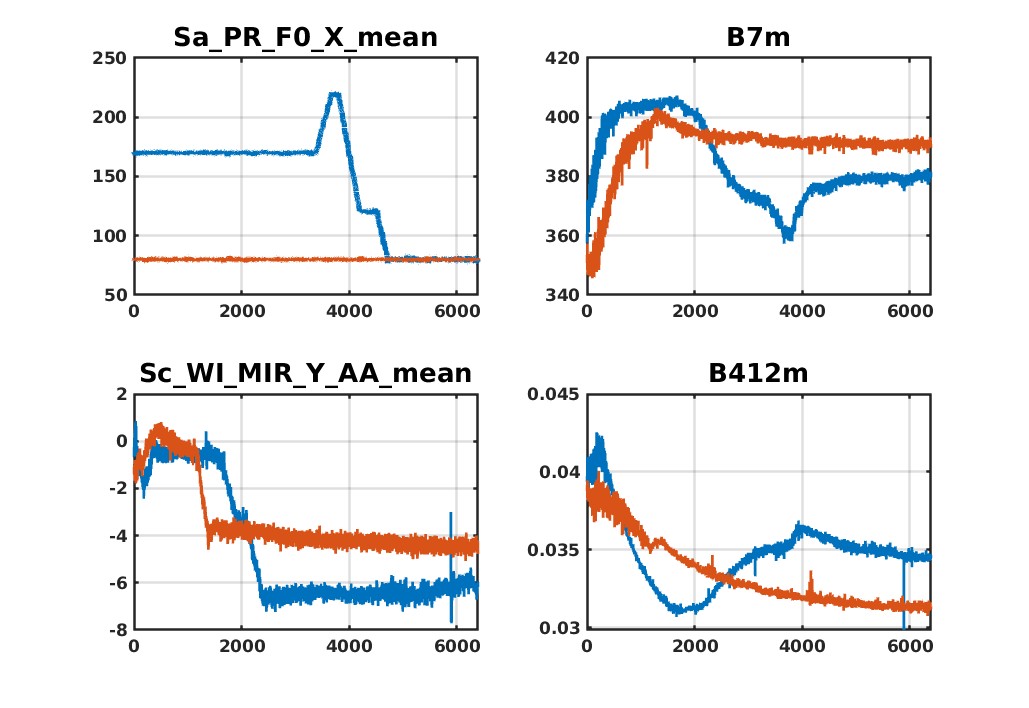
gps2=1474633548 --- lock acquistion in the same condition as gps1 (WI 2mm up). During the lock, an offset has been applied to the dither signal NI_Y in loop, imposing a different alignment of the cavity optical axes. In this way, the spot on both the ITMs has been shifted downwards. The amount of this shift was much larger than the one performed by the physical displacement of WI (~ 6 mm). The effect on the sidebands was much more evident, but the carrier's power has dropped a bit, likely because of the mismatch between the input beam the the optical axes.
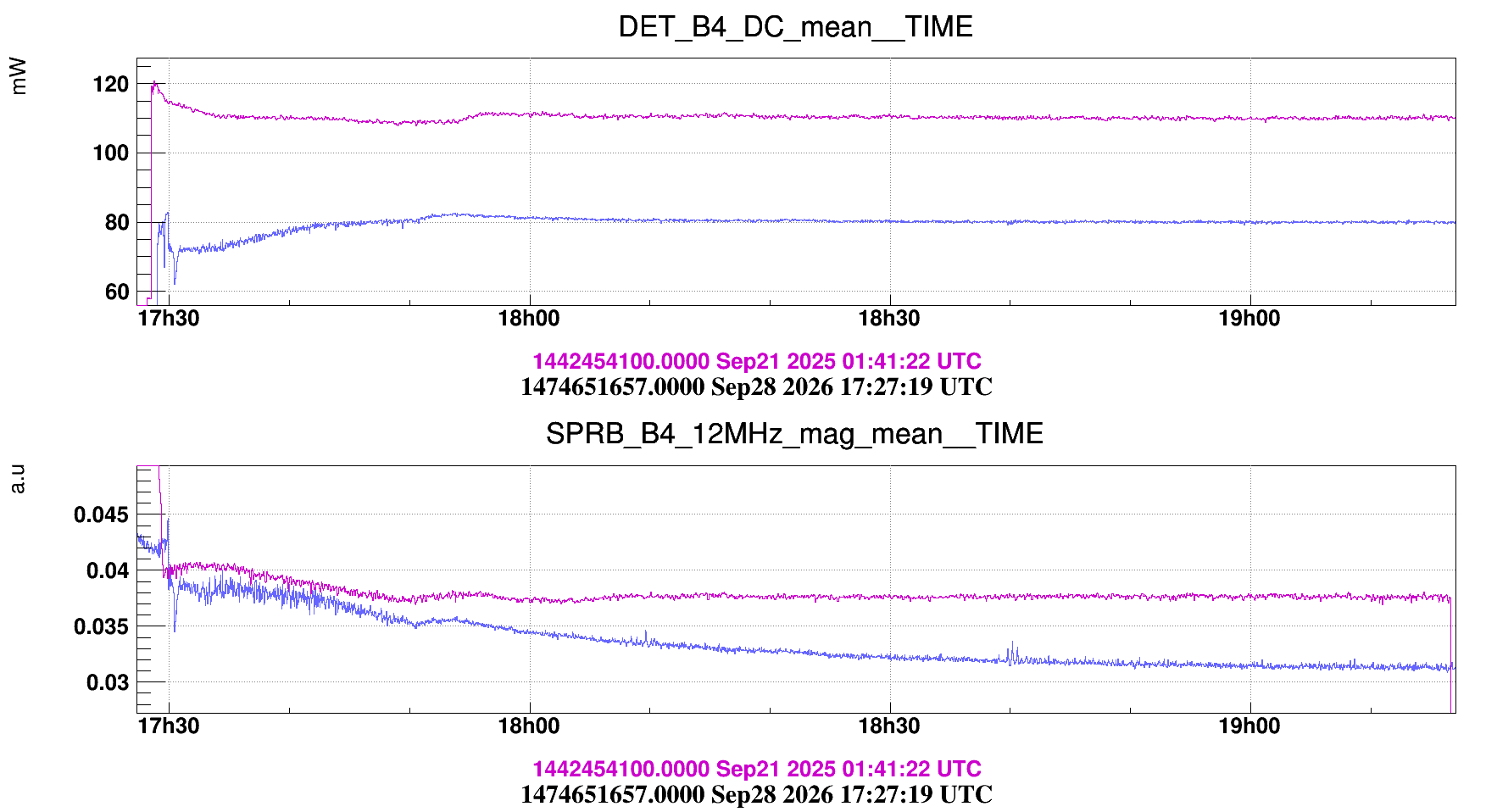
gps3=1474651865 --- the input beam has been shifted vertically before the lock, by a combination of PR translation and BPC-SIB1 rotation. We did only 3-4 mm, because doing more would have brought BCP sensing too close to the end of the range. The lock has been acquired in this misaligned condition, then the alignment has been recovered applying a corresponding offset to NI_Y (lower than the one operated in the previous lock). The carrier was higher than before, but not at its maximum level. The sidebands were lower than before, but the lock was stable enough, it lasted almost 2 hours and the unlock was due to a glitch of NI inverted pendulum.
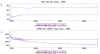
In the attached figures the comparison of consecutive locks is shown: fig1 gps0 vs gps1; fig2 gps1 vs gps2; fig3 gps2 vs gps3. Carrier, sidebands and vertical position of the spot on WI (dither signal) are taken into account. The first plot in the grid shows the action performed during the lock.