During the day, we will try to stabilize CARM NULL 1F with the goal to have the possiblity to tune the DAS directly at CARM NULL.
The starting point is the following:
|
| starting point | CH [W] | INNER DAS [W] | OUTER DAS [W] |
| W | on the ITF | 0.022 | 0 | 0.4 |
| on the pickoff | 0.135 | 0 | 0.065 | |
| N | on the ITF | 0.022 | 0.15 | 0.6 |
| on the pickoff | 0.135 | 0.024 | 0.098 |
We performed some tuning attempts. The first step regarded the CH.
We increased CH powers by 18 % at 9.24 UTC.
At this point, we were able to reach CARM NULL 1F quite systematically. However, the ITF was repeatedly unlocking because of the high power on B1p, which exceeded the threshold for triggering the fast shutter (0.2 mW).
We therefore contacted DET to slightly increase the B1p DC threshold. Michal increased it from 0.2 mW to 0.25 mW.In parallel, in an attempt to reduce the B1p fringe, at 12:26 UTC we increased the WI DAS outer ring power by a factor of 2, assuming that the WI absorption is approximately twice that of the NI.
|
| STEPS 1-2 | CH [W] | INNER DAS [W] | OUTER DAS [W] |
| W | on the ITF | 0.026 (+18%) | 0 | 0.9 |
| on the pickoff | 0.160 (+18%) | 0 | 0.150 | |
| N | on the ITF | 0.026 (+18%) | 0.15 | 0.6 |
| on the pickoff | 0.160 (+18%) | 0.024 | 0.098 |
After that, we realized that the DIFFp loop had not been working properly since yesterday.
The issue was fixed, and we continued with the lock acquisition tuning. However, we then noticed another problem with the COMMp loop and decided to keep both the COMMp and SOFT loops open.
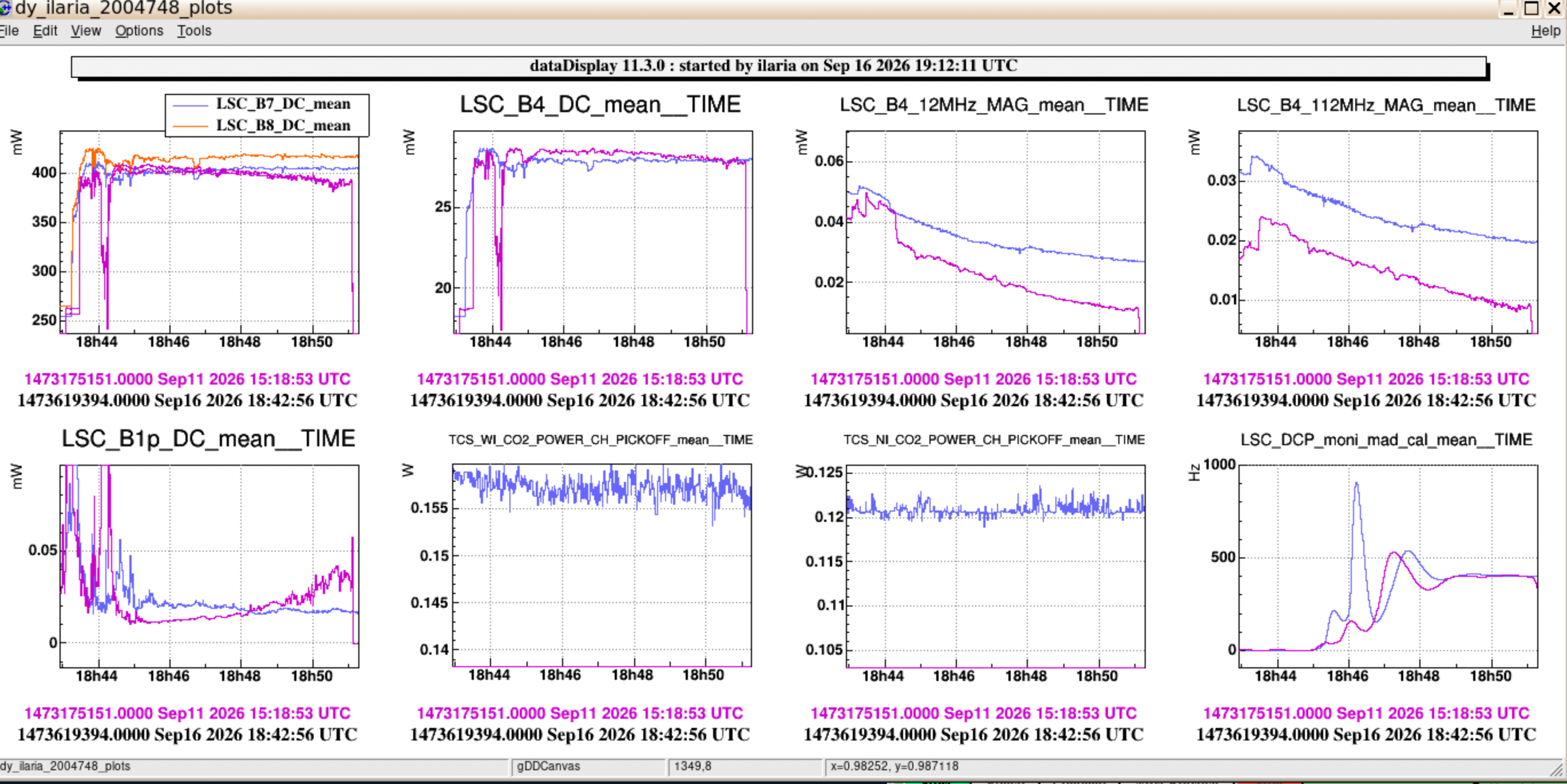
With this configuration, we were able to reach CARM NULL 1F and maintain the lock for about 10 minutes.
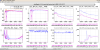
In the first figure, the two CARM NULL locks with and without TCS are shown. The situation seems to be improved at the sideband level.
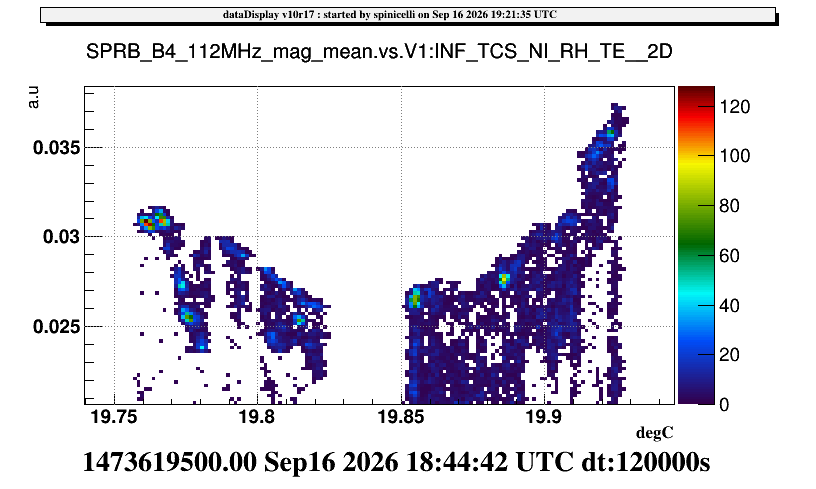
Concerning the etalon, the sinusoidal behavior is clearly visible. The increase of 112 MHz observed in the upper-right corner of the plot shown in Fig. 2 is due to the change in the DAS settings.