Reports 1-1 of 1 Clear search Modify search
AdV-INJ (General opto-mechanical layout, common parts construction, Installation and pre-commissioning)
melo, derossi, lagabbe, gosselin, spinicelli - 17:42 Friday 08 May 2026 (69097) Print this report
chiller malfunctioning

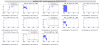
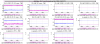
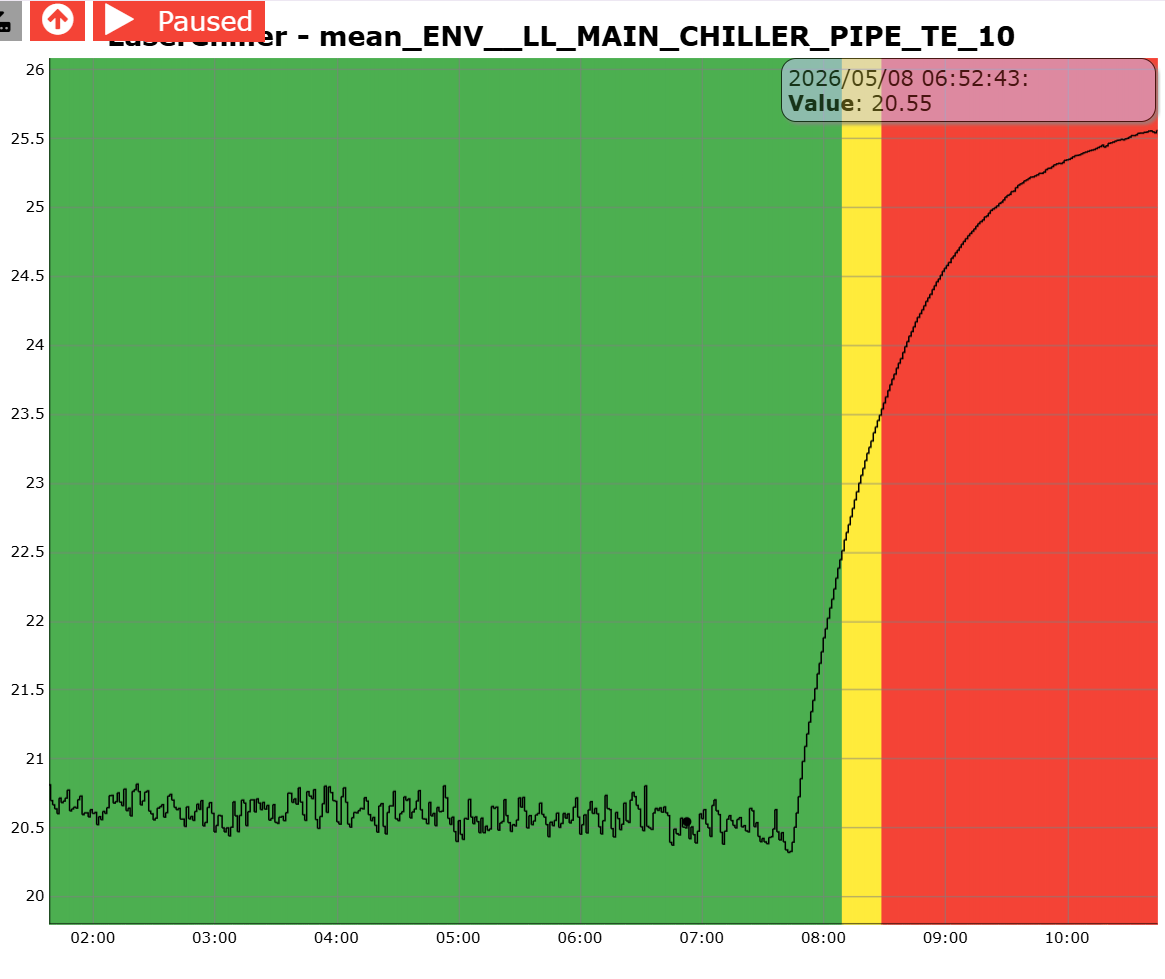
We went to EEroom to investigate the chiller, since we noticed that the CHILLER_PIPE_TE monitor suddenly increased a lot (see Fig. 1). Inside the chiller room, there was an allarm for one of the two chillers (the THERMOTEK chiller), so we filled it in with water (water flow was low) and swapped the filter that seemed a bit dirty, but it didn't restarted after this operation. After some trials we decided to use the spare chiller instead.

However, the OMI chiller wasn't working properly as well (linked to the DMS allarms) but we couldn't identify the problem. So, we decided to switch off everything for safety reasons for the weekend (Neovan amplifier and slave laser pump currents wer set to 0). 


Images attached to this report
Comments to this report:
derossi, lagabbe, spinicelli - 12:38 Tuesday 19 May 2026 (69110) Print this report

This morning we went in the Eeroom to check the INJ chillers.

- the MAIN CHILLER Omi (which is used for the SL diodes in EEroom, SL crystal in LL and Beam dumps IPC (EIB) + IMC REFL (EIB but not connected) + PMC REFL (LB) + B2 (SIB2) + IPC2 (SIB1 flux blocked)) when switched off was giving the error A05. We changed the filter and switched it on and it was working fine. We switched it off again.

- the NEOVAN HEAD CHILLER Termotek (used for the Neovan head). We switched it on with the circuit closed on itself and this time the pump started (we observed this behaviour also in the past, maybe due to the air which enters while changing the filter)

gosselin, derossi, lagabbe, melo, spinicelli - 17:59 Tuesday 19 May 2026 (69114) Print this report

While performing these tests, we noticed that the SL crystal temperatures were unusually high.
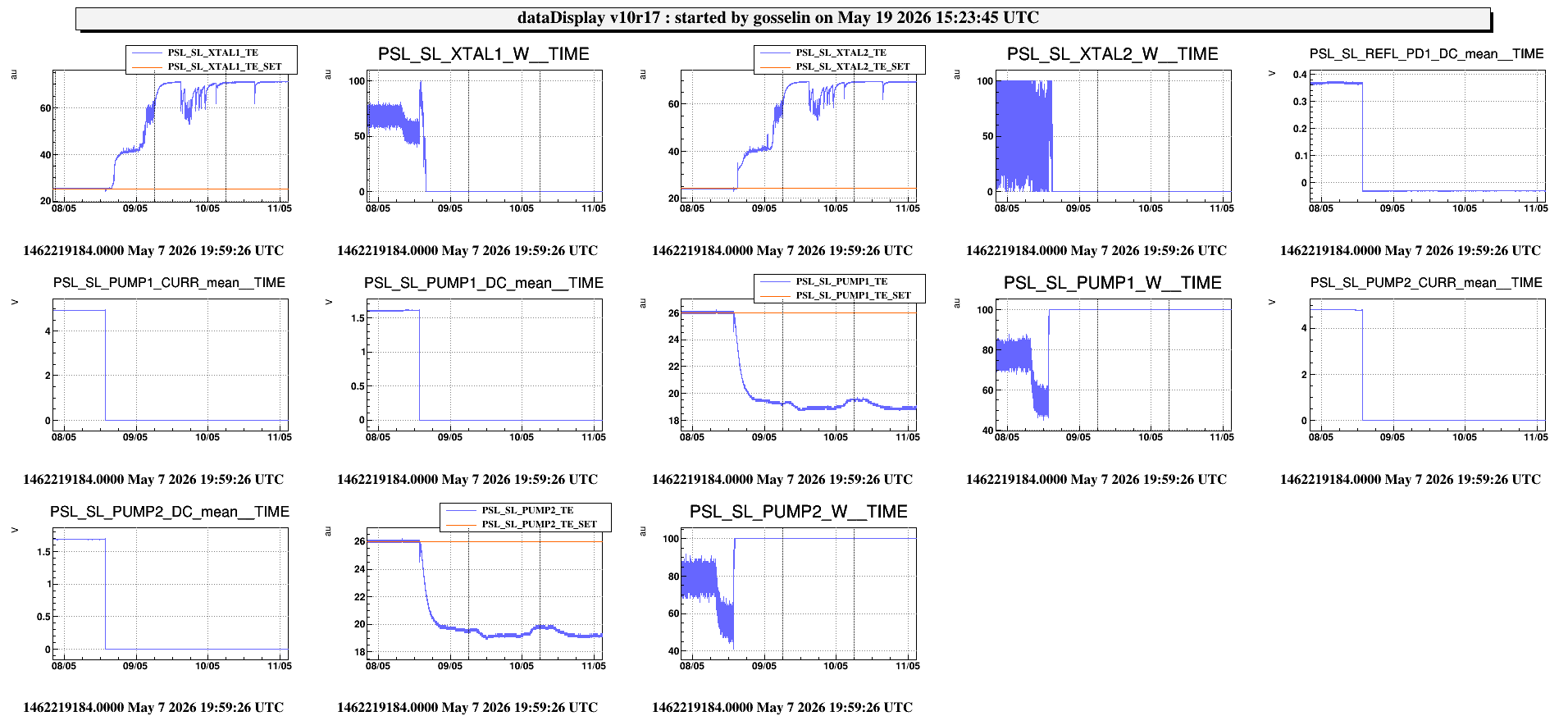
By checking the trends, we observed that the temperatures started to rise and eventually reached approximately 70°C after the pumping diodes were switched off on 07/05.
This suggests that the temperature controllers are not responding properly in the present configuration.

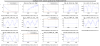
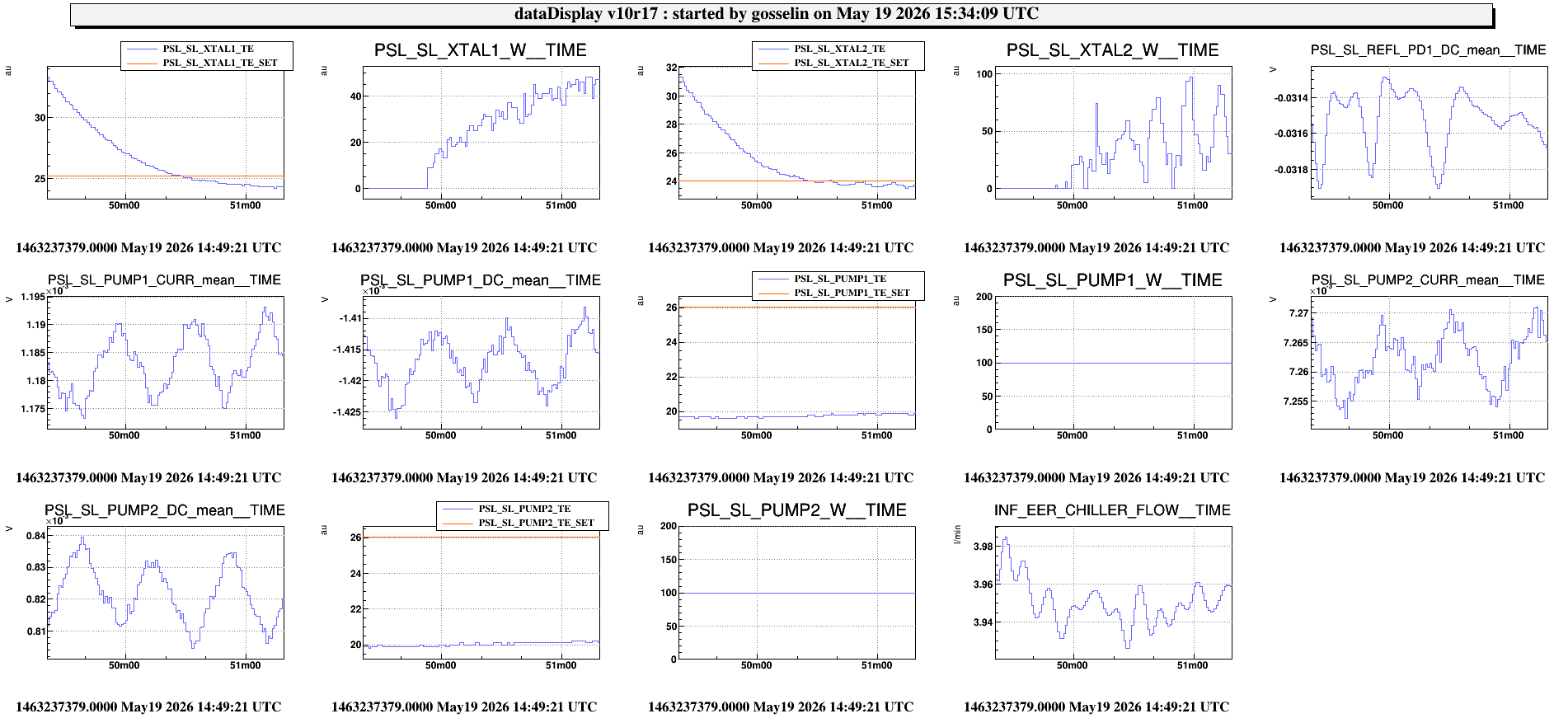
Under normal operation, both the pumping diodes and the crystals have their temperatures stabilized by the Peltier modules (W signals on the fig attached) in order to maintain the temperatures at their setpoints (SET signals on the fig attached).The hot side of the Peltier modules is itself cooled by the chiller.

Usually, when the pumping diodes and the chiller are switched off, the correction signals go to 100 and everything remains at low temperature.
We had never paid particular attention to this behavior before, but it is already somewhat anomalous, since the controllers should regulate around the setpoints rather than continuously applying maximum corrections.

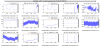
When we switched off the chiller and the pumping diodes on 08/05, the behavior was different for the crystals: instead of going to 100 as observed for the pumping diodes, the Peltier correction signals for the crystals dropped to 0, and the crystal temperatures started to increase (figure 1)
This behavior is currently not understood. 0 corrections should be the lowest temperature...

The crystals eventually reached approximately 70°C.
When restarting the SL, we will need to assess whether this may have caused any damage and whether the alignment has been affected.

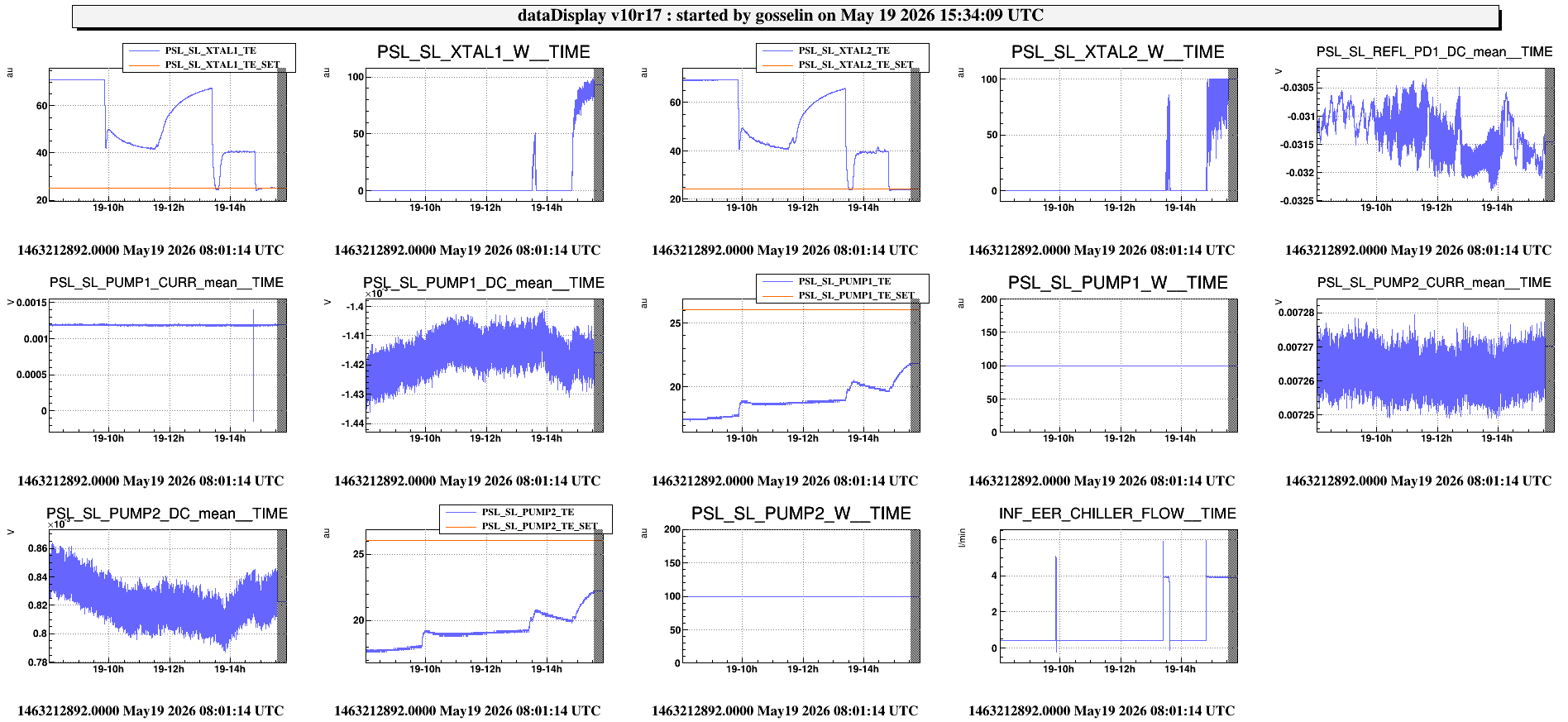
After noticing the issue and we saw that the crystal temperatures were increasing again (figure 2) : without changing anything on the chiller nor the peltier corrections, at 11:30 UTC the temperature of the crystals started to increase again from 40 degrees towards 70 degrees.
So we went to the chiller room to restart the chiller. The Peltier modules only resumed normal behavior once the temperature became close to the setpoint (figure 3).

Images attached to this comment
gosselin, derossi, lagabbe, spinicelli - 18:06 Thursday 21 May 2026 (69123) Print this report

20/05

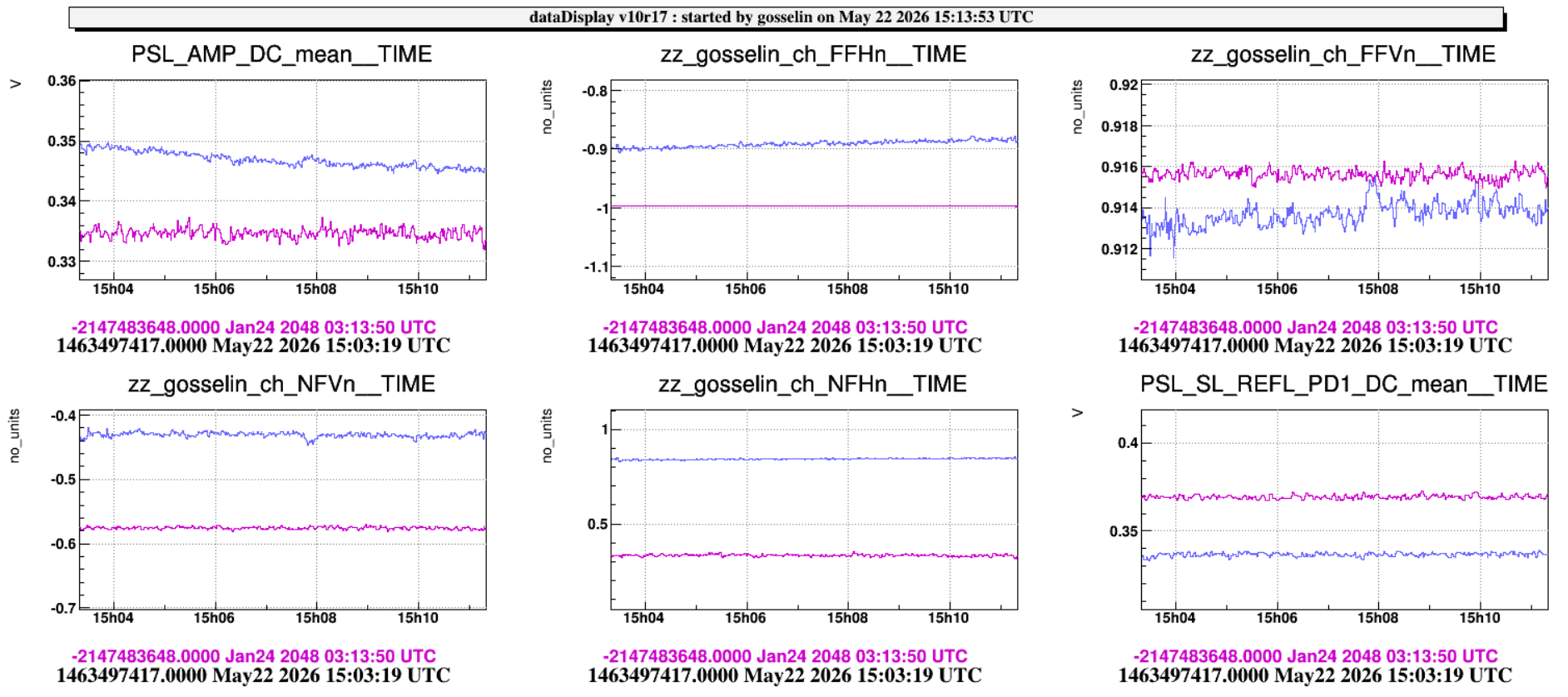
Yesterday, while relocking the SL, we noticed that the reflection was quite low: 0.22 V instead of the usual 0.38 V.
When the NeoVan was seeded only by the ML, we obtained higher power than when it was seeded with both the ML and SL.
The SL PUMP DC signals, which monitor the pumping diode power at the output of the fiber in the SL head, were also higher.

This indicates a general misalignment of the SL cavity that needed to be cured. 

Since the temperature of the NeoVan was increasing, we decided to slightly reduce the pumping diode current overnight while keeping the SL running, hoping that thermalization during the night would improve the situation.

21/05

No thermalization effect was observed overnight.

In the morning we held a meeting with Walid and Margherita to analyze the situation. We agreed that the beam of the pumping diodes needed to be realigned inside the crystals. Since the power was already quite high, we were expeting a slight misalignment that could be recovered by ajusting the lenses in front of the cavity (at least as a first try).
We then went to the laser lab in the afternoon to perform the adjustment. By tuning the vertical and horizontal position of the lenses, we managed to recover the reflection signal up to 0.32 V.
We did not fully recover the nominal value, which was quite expected since we only had a limited number of degrees of freedom available compared to the full possible misalignment that may have occurred.

We also measured the slave locking bandwidth (14:51:02) and found 1.15 MHz, significantly lower than the 2.1 MHz measured last time we did it. This further confirms the presence of a misalignment of the cavity. 
Also, visually, we observed that the beam was not propagating correctly through the optics toward the NeoVan, so we decided to flip the mirror located between the SL and the amplifier. 

Peltier situation:

When the safety interlock triggered on 08/05, the PID temperature controllers did not stop sending correction signals. This was verified this morning by manually triggering the safety system.

Our hypothesis is that, during the afternoon of the 08/05, without cooling from the chiller on the hot side and while the system was still attempting to cool the crystal, the Peltier element of Crystal 1 was receiving 2A and experienced an overall temperature increase. This eventually resulted in a general temperature rise of both peltier, both crystals and likely the whole cavity. 

gosselin, melo, lagabbe, spinicelli - 18:05 Friday 22 May 2026 (69125) Print this report

fter discussing it with Walid in the morning, we decided to intervene on the SL fiber alignment to see whether we could recover power at the slave output and improve the cavity alignment toward the Neovan.

We started by switching off the SL and taking additional references of the beam going from the ML toward the neovan (in reflection of the SL), since we had previously observed that the Neovan output power was quite good when it was seeded only by the ML.

We then worked on the alignment inside the SL cavity by acting on the vertical and horizontal axes of both fibers, recovering the alignment with the lenses, trying to maximize the output power. We managed to recover about 0.34 V, starting from 0.32 V. We could not go higher and get back to the 0.38V because both axes of the lens on the western side had reached the end of their coarse adjustment range.

From there, having only 10% missing, we started to check the alignment toward the Neovan, and it was better than what we had yesterday. We had to slightly adjust the tilt by acting M0.4 (second mirror at SL output).
We injected the SL into the Neovan and slowly increased its power using the IPC between the two.

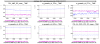
We eventually recovered 0.35 V on AMP_DC, which is better than what we had before. From the AMP diagbox QPD signals, the beam appears to be mainly shifted horizontally compared to its previous position (figure). In addition, the temperature of the Neovan head is slightly higher, around 31°C instead of 30°C.

We did not try to realign the PMC for now, but looking at the peaks on PMC_TRA, it appeared to be misaligned, as expected given the signals on the AMP QPD.

For the weekend, we decided to flip the mirror between the SL and the Neovan and reduce the current of the Neovan pumping diodes to avoid the head to overheat. We will monitor the thermal behavior of the SL over the weekend.

The next steps are to reinject again the SL into the Neovan, check whether a slight alignment of the beam inside the Neovan could further increase the output power, and realign the PMC in order to eventually try locking it.

Images attached to this comment
gosselin, spinicelli - 16:48 Monday 25 May 2026 (69129) Print this report

The slave laser remained stable over the weekend, so this morning we continued working on the alignment.
We seeded the Neovan with the SL and everything was as we let it on Friday afternoon.

We first attempted to optimize the alignment using the mirror in front of the Neovan while monitoring both the transmitted power and the beam profile on AMP_cam.

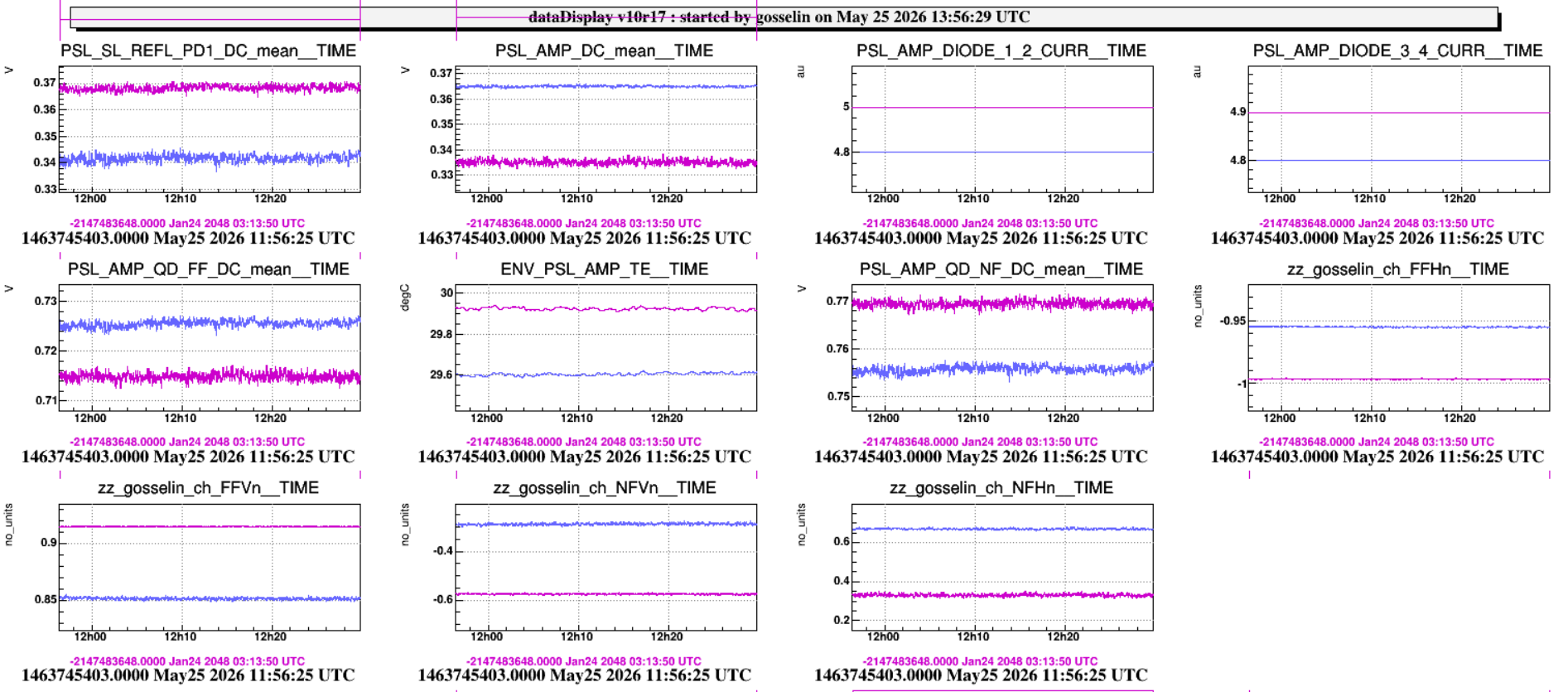
Since the improvement remained limited and the AMP NF was still significantly away from what it was before, we decided to realign the SL beam towards the Neovan using LB_M04 (the second mirror after the SL) hoping for both effect on the shift and the tilt of the beam inside the neovan. This proved to be very beneficial for both the output power and the beam profile. We managed to recover 0.38 V on AMP_DC.

We then adjusted the Neovan pumping diodes to investigate whether the situation could be further improved. We decreased the current of all four pumping diodes by 0.1 A and obtained a better output beam shape together with a lower temperature of the Neovan head, while maintaining good output power (Figure 1).
New pumping diode current values: 4.8 A.

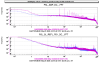
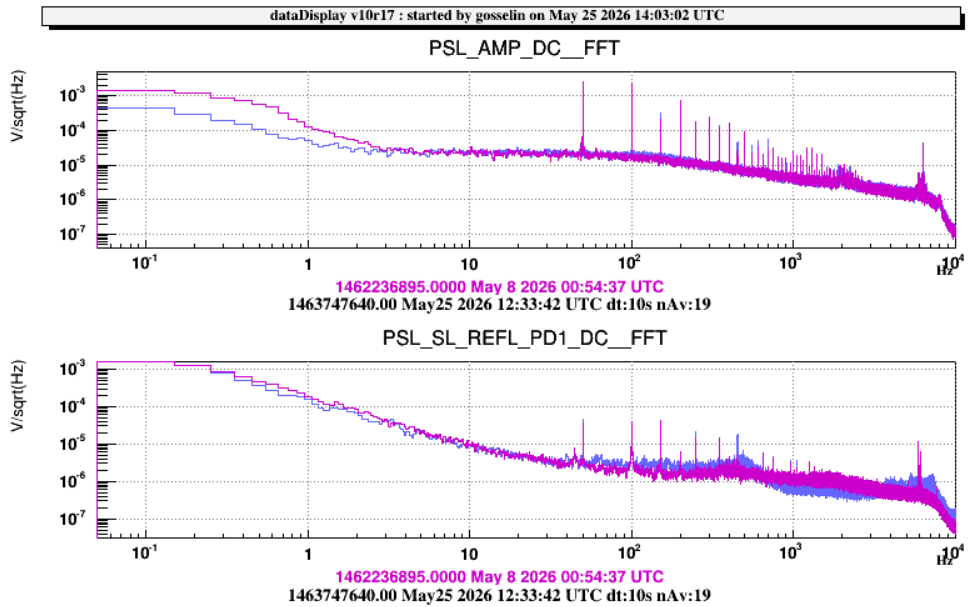
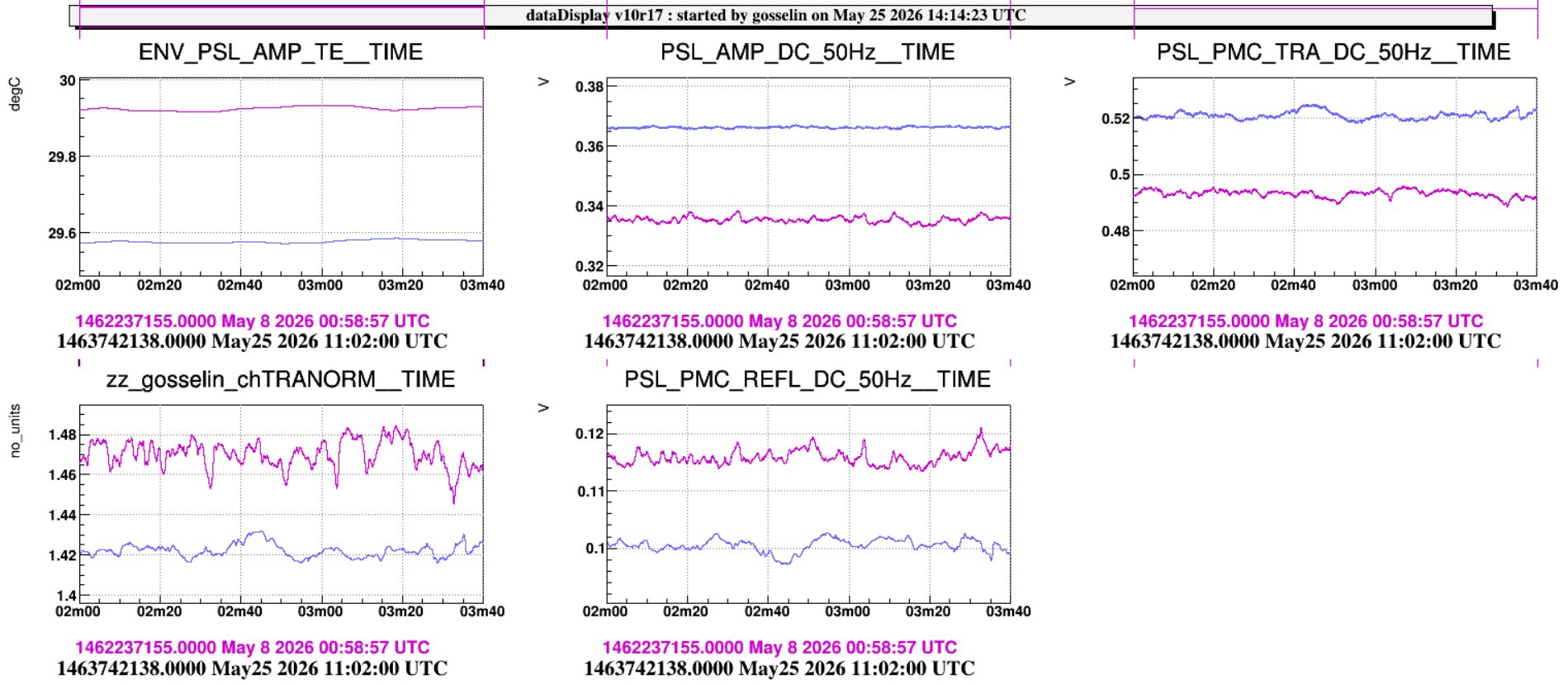
Overall, we now measure 0.37 V on AMP_DC, compared to 0.34 V previously, and the low-frequency noise is reduced (Figure 2).

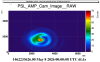
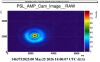
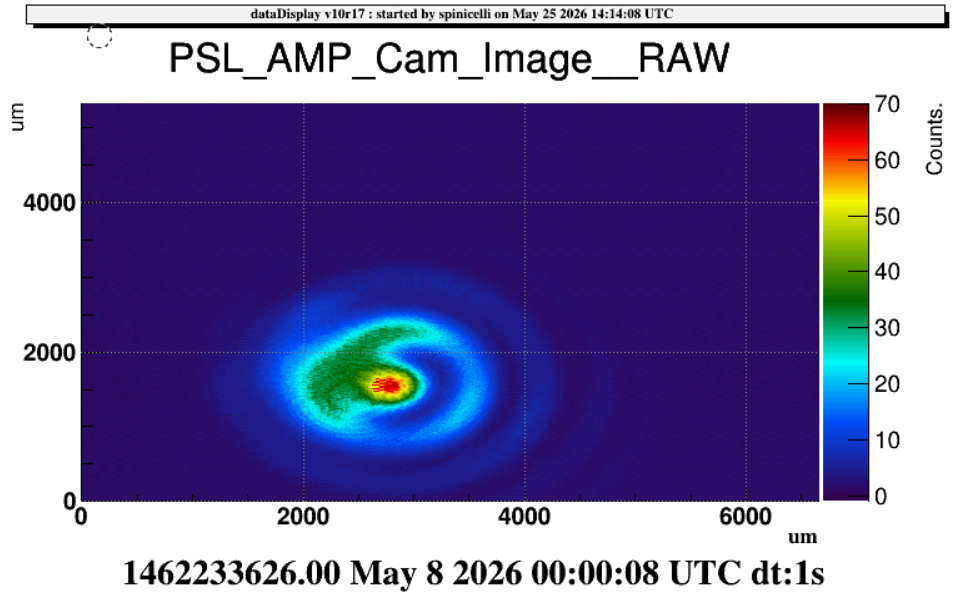
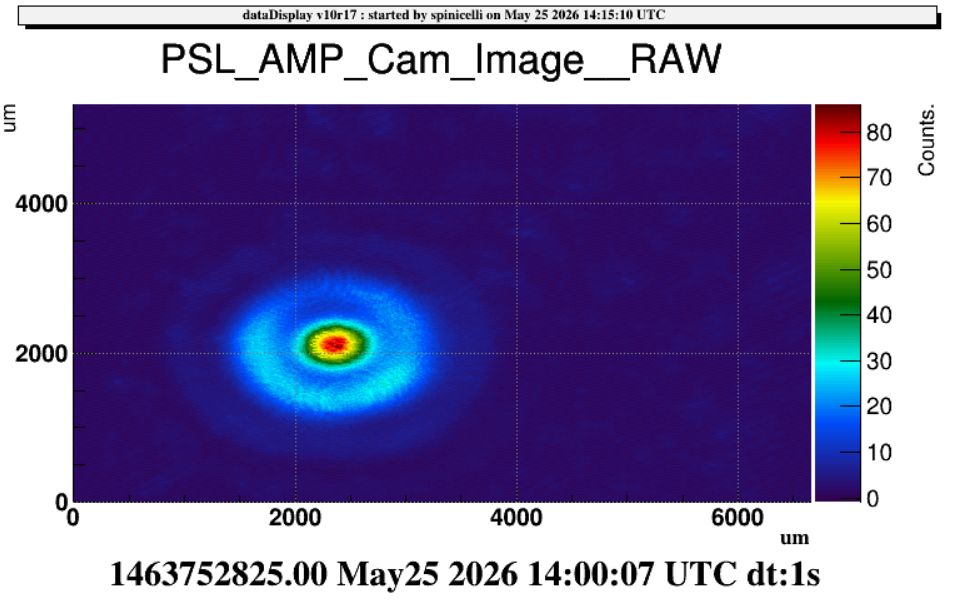
The beam shape also looks improved (Figures 3 before and figure 4 after).

Having recovered both good output power and a good beam shape, we proceeded to work on the PMC alignment.
We realigned it and now measure 0.52 V at the output, compared to 0.49 V previously (Figure 5).

While normalizing PMC_TRA and PMC_REFL with AMP_DC, the throughput initially appeared lower. However, after further inspection, it seems that about 3.7% is still coupled into the TEM01 mode. This should recover once the system is fully thermalized. The mismatch is instead around 1%.

We also computed the throughput using PMC_REFL in the unlocked and locked states. We now estimate throughput losses of 20%, whereas they used to be around 22%.

It should be noted that, since the IMC transmission signal is currently unavailable, we could neither work on the PSTAB nor easily verify the alignment in the AOM. These checks will need to be performed later. However, only minor adjustments were required for the alignment towards the PMC.

We let everything locked for the coming days for thermalization. Fine alignment of the PMC as well as check of the order 1 in the AOM will be done on wednesday. 
Images attached to this comment
Search Help
×

Warning

Error

The present report has been modified outside this window. Please check for its integrity in the main page.

Refreshing this page will move this report into drafts.

×