Last Thursday a large longitudinal working point offset was observed in the IMC locking loop. In addition, the RF QPD in near field used for IMC alignment did not appear to behave correctly.
Given the significant mode mismatch previously measured (~13%), we redistributed the power by reducing the PMC input by 20% and compensating with IPC1, with the aim of modifying the thermal lens in the EOM and Faraday. Following this change, the mismatch improved to ~9%.
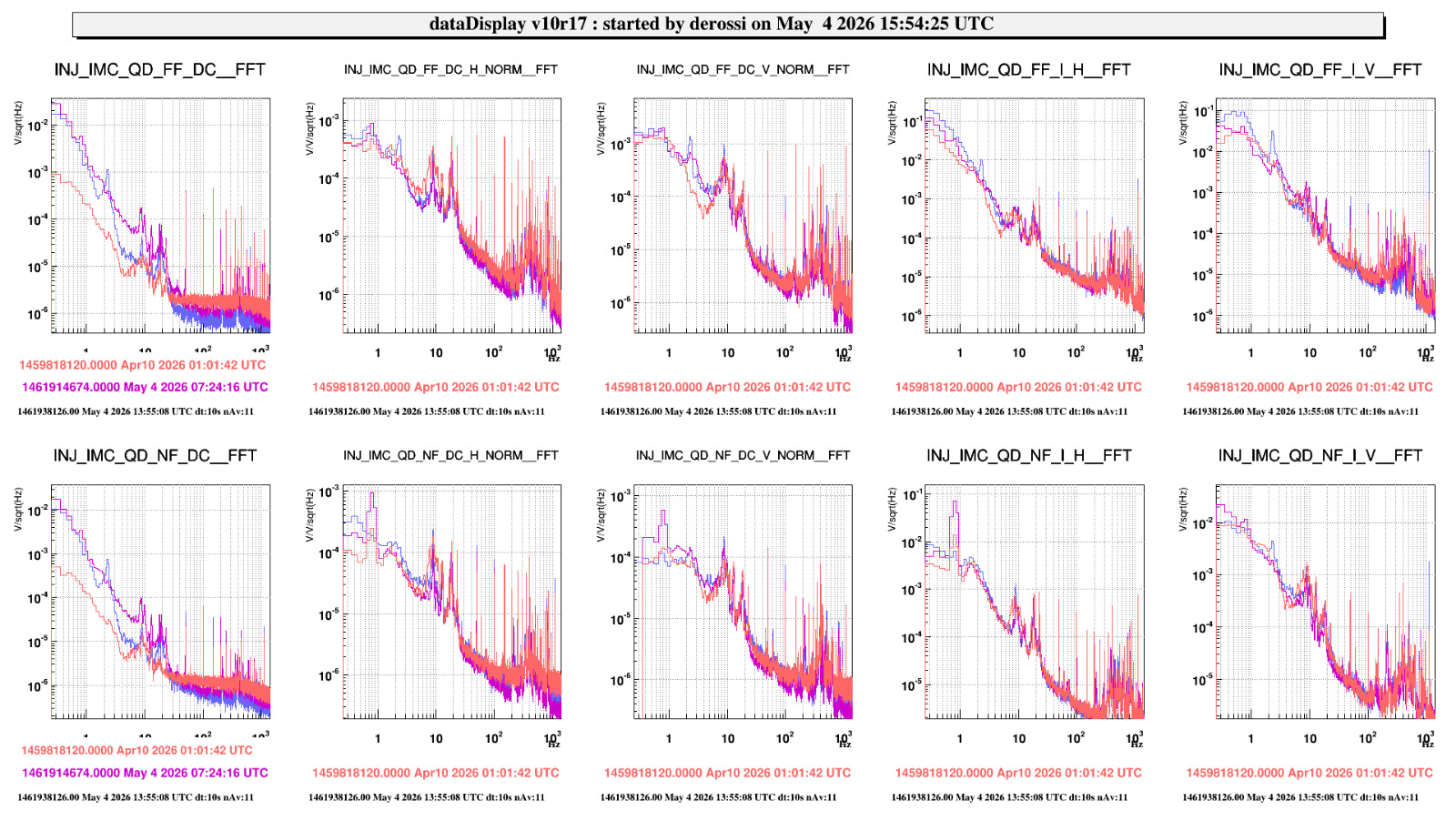
In parallel, a peak at 0.8 Hz was identified in the RF QPD spectra. Maria and Irene performed a Bruco analysis and found coherence with MC TY, suggesting that the feature originates from the AA matrix.
We then optimized the IMC alignment and remeasured the sensing matrix. The 0.8 Hz peak on the horizontal signals was significantly reduced (see comparison plot between Apr 10, this morning before power reduction, and now). However, the longitudinal working point remains large and comparable to last week. Checks of the 22 MHz signal and the RF photodiode after the EOM (EOM_EAB_TRA) do not show any increase in amplitude modulation, leaving this effect unexplained.
To further investigate the mode mismatch, beam profile measurements were performed on EIB after M5 under two thermal conditions: current configuration and with PMC_TRA increased by 20% (as earlier this morning). The goal was to identify possible thermal lensing, including its position and focal length.
Measurements (around 17:17 LT, low PMC power, 29.6 W after EIB M5, IPC1 = -54250 step, ~4.4 mW sampled after M5) :
z from M5 (mm) ellipticity beam width (um)
85 97 1280 um
135 98% 1290
185 100 1380
235 100 1420
285 1470
335 1480 (1530)
After increasing PMC_TRA by 20% (17:24 LT, ~5.3 mW sampled),
85mm 97% 1260
135 98 1305
185 99 1360
235 97 1405
285 96-97 1490
335 98 1520
The measurement sequence ended at 17:37 LT, and the system was returned to low PMC power at 17:44 LT (IPC1 = -51500).
A preliminary analysis of the beam profiles indicates a waist of ~508 µm located at -0.49 mm from M5 in the low-power case, and ~444 µm at the same position in the high-power case (+20%). Using the known waist at the output of the LB (639 µm at 13 cm from EIB), these results can be reproduced by introducing a thermal lens in the third EOM with a focal length of ~1090 mm (low power) and ~900 mm (high power). The variation in focal length is consistent with a linear dependence on absorbed power. Quantitatively, this would correspond to an effective absorption on the order of ~2000 ppm, significantly larger than the expected 50 ppm/cm for a 20 mm crystal.To be followed.
Additional activity :
Realignment and calibration of EIB POUT : 34.5 W on the channel with 0.485 PMC_TRA_DC while 29.6 W have been measured.