This morning we scanned the longitudinal position of the SDB1 bench in order to study the impact of the OMC mode matching on the interferometer figures of merit with the ITF locked in LN2.
The conclusion of the shift is that we were able to improve the optical gain by about 3% when displacing the bench by -3000 um. We tried a further bench displacement but without clear conclusion on the optical gain and BNS range, thus we came back to the previous position.
Since at the beginning of the shift the ITF did not reach LN3, we decided to work in LN2. Maddalena engaged manually the high bandwidth control of BS.
Activity starting at 08h45 utc with ITF in LN2 and BS full bandwidth engaged.
Initial position of SDB1 bench is : SDB1_LC_Z = 3708 um , Sa_OB_F0_X = 2600.
Start a ramp of -3000 um at 08h53 utc (Fig.1). We observed that the optical gain has increased by about 3% while moving the bench by- 3000 um. The BNS range also seems to have improved (by maximum 1Mpc) but it is not very clear if this is linked to the motion of SDB1. The DPC frequency was rather stable. From Fig.2 we can see that the decreasing power trend on B1p and B1s was already present during the previous lock. It is likely to be still the transient of the etalon effect. While scanning SDB1 bench we also observed a decreasing of the B1s DARM signal, which clearly indicate an improvement of the mode matching.
ITF unlocked at ~8h39 utc. The ITF was relocked in LN2 and Camilla engaged the BS in highbandwidth. We started collecting reference data from 10h14 utc. Unfortunately we noticed later that the B1p QD1 galvo loops were open. So we closed them at 10h21m43 utc.
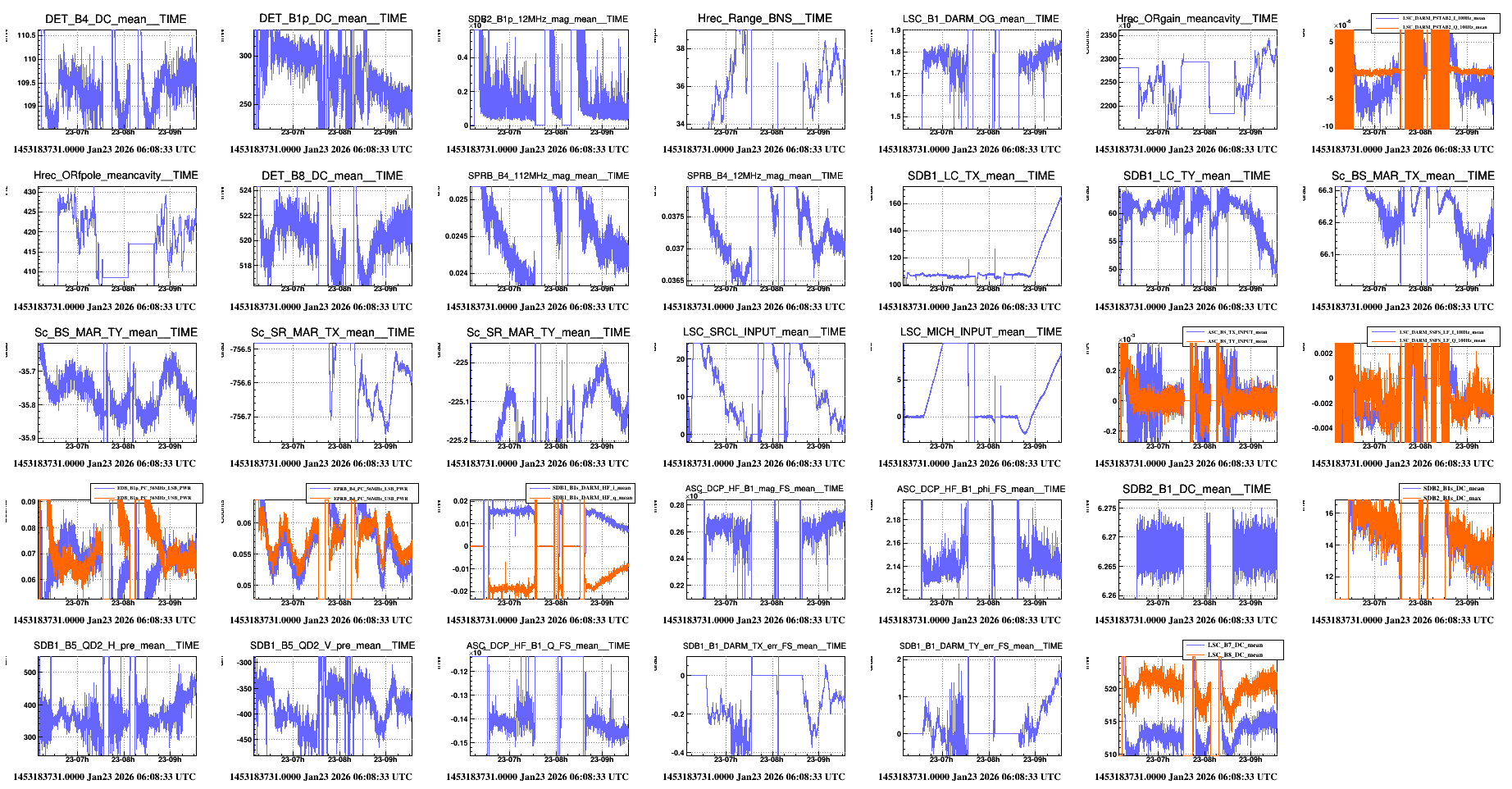
At 10h32 utc we restart the SDB1 Z scan, moving down by -1300 um. Since we started observing a degradation of the BNS range and some fluctuations on the optical gain (while the B1s DARM signal was getting close to the zero crossing), we stopped the SDB1 scan, at the position corresponding to SDB1_LC_Z = 90 um. Looking at the trends on Fig.3, it seems that the degradation of the BNS range and the CMRF is not linked to the bench motion, as the situation seems to get back to normal after a moment.
We restart the scan at 11h11 utc, moving by about -700 um (see Fig.4). Another ITF unlock at 11h22 utc. It seems that we have reached the zero crossing of the B1s DARM signal. Besides this, we do not see any improvement (or any clear degradation) correlated with the last scan of the bench.
ITF relocked in LN2 at 13h16 utc. We bring back the bench at the position corresponding to OB_F0_X = -400 um (and SDB1_LC_Z = +1185 um ) where we have found a better optical gain this morning. This position is reached at 13h30 utc. We will now use it as new nominal position for SDB1.
New SDB1 TX/TY setpoints (TX=180, TY = 48) updated in SDB1_LC configuration file at 13h37 utc.
.png)
.png)
.png)
.png)
.png)
.png)