Motivation: Tommorrow we will try and optimize the input mode matching. This is based on elog 67078 which concluded that the input mode matching was suboptimal.
In May last year, the west arm test masses were changed. So, I will not summarize any measurements prior to that date. Clément and I did some measurements during the west mirror swap, and those are summarised in VIR-0907A-25.pdf
June Measurement (mwas, elog 67078)
In June, Michal et al. changed the RH powers.
North: 7.4 W -> 3.4 W
West: 8.1 W -> 4.0 W
At the same time, a noise peak in DARM shifted from 10700 Hz to 11500 Hz.
December Measurements (cjacquet et. al.)
NB: In all cases I take the FSR to be 49968 Hz.
December 2nd (Elog 68300)
Clément and I took some data, but no results were posted and I have not reanalyzed the data.
December 15th (elog 68385)
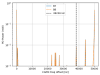
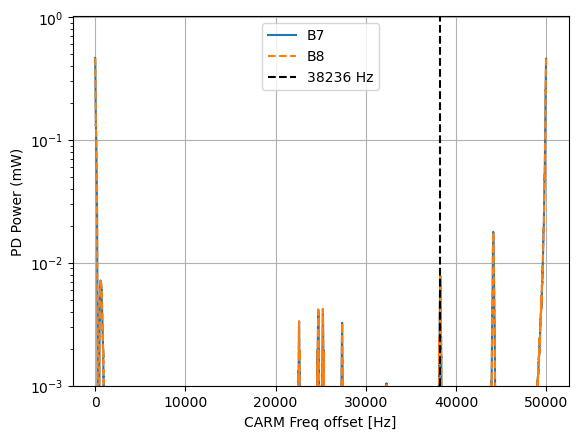
Scans were taken using a CARM offset. This means there was no 1064nm beam and so no thermal lensing, the method is described in the Opt Char Measurement guide. The ring heaters were off. Using a quick python script, I found the 2nd order mode separation to be 11,731 Hz or 0.235 fractional FSR. See attachment 04. Note that I used a "downward" scan, so the frequencies in the graph need to be read as FSR - f,
My quick python script was done "blind" to validate Cléments results quasi-independantly, but I present it here as part of a coherent narrative.
December 19th (elog 68417)
On December 18th the cryotrap was closed, in the morning, it was opened and the effect the on the mirror observed. As the mirror cooled down, A shift from a fractional FSR position of the second order mode from 0.241 -> 0.236 was observed. This was 12,042 Hz -> ~11731 Hz. Details can be found in his elog. RHs were off.
December 22nd (elog 68423)
On December 22nd, the RH's were tuned on in both arms. At the start of the measurement the RH's were off, then turned on into their nominal configuration, as listed above. Details in Cléments log. For both arms, the shift was RH off, 0.235 (11,742) ->RH on, 0.205 (10,243 Hz).
The RH configuration was
NE Coil 1 16.6026 V, 0.272 A, NE Coil 2: 16.6030 V, 0.271 A
WE Coil 1: 17.402 V, 0.290 A, WE coil 2: 17.400 0.295 A
Voltage uncertainty +/- 0.0001 V; amperage uncertainty +/- 0.001 A. This was stable across all measurements (as report by in loop sensors, so caveats apply).
This amounts to 8.53 W in the north arm and 10.36 W on the west arm (note this was tuned again in as of Thursday 22nd at 17h00 it was 8.65 W and 10.19 W).
Summary of measurements so far
Putting these in a line we have:
- 10,235 Hz (ring heater + cryotrap)
- 11,731 Hz (No Ring heater + cryotrap)
- 12,042 Hz (No ring heater + no cryotrap)
Estimating hot curvature - part 1 true curvature.
In VIR-0907A-25.pdf, on page 8, Clément gives the LMA measurements as:
LMA_measurements = dict(NI=1424.6,NE=1692.6,WI=1425.5,WE=1695)
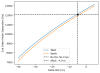
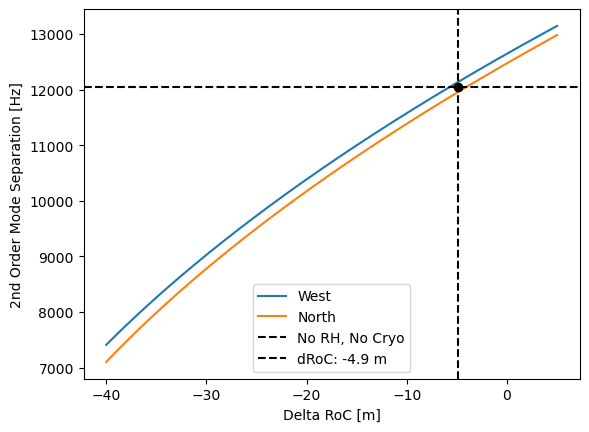
Based on his work, we suspect a descrepancy between the LMA measurement and the in situ measurement. Our leading explaination for this is a systematic error in the measurement at LMA, which would be common for all mirrors. Calculating the mode separation frequency for several different offsets, we can find an intersection at -4.9m. See attachement.
Estimating hot curvature - part 2, Cryotrap
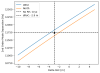
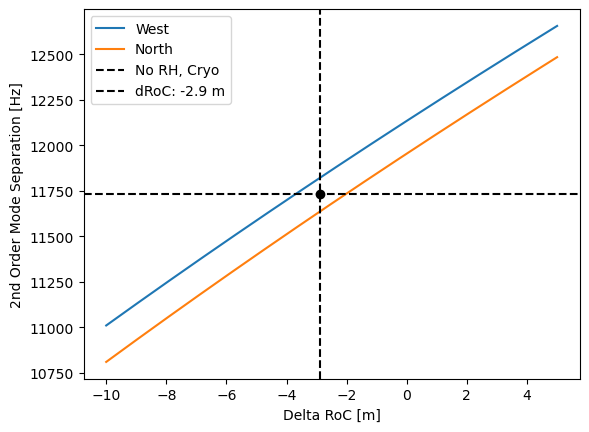
We can then repeate this measurement for the effect of the cryotrap and find it is -2.9m
Estimating hot curvature - Part 3, Estimating the effect of the RH
Now, given the static offsets, we can now compute the effect (assuming all of the effect of the RH is on the ETM). Given a IM RoC (computed above) and a second order mode seperation, we can compute the RoC change on the end mass. In both cases it comes out to -25.0m, i.e. the RoC gets shorter and the mirror is more curved.
The NE RH was set to 8.53 W, therefore, -2.92 m/W
The WE RH was set to 10.36 W, therefore -2.41 m/W
The analysis for parts 1 and 2 is in this python file https://git.ligo.org/IFOsim/Finesse_playground/-/blob/ed62f5543fb6596fe66c889aa6f86c031e3722b9/aaron_jones/2026_virgo/03a_utils.py
Estimating hot curvature - part 3
We can then recalculate the curvatures for the RHs after the TCS tuning last thursday. The method is shown in this file and relies upon Ilaria's TCS tuning documents:
The expected second order mode freq for the hot ifo with the RHs is: North: 11679 Hz West: 11901 Hz
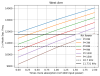
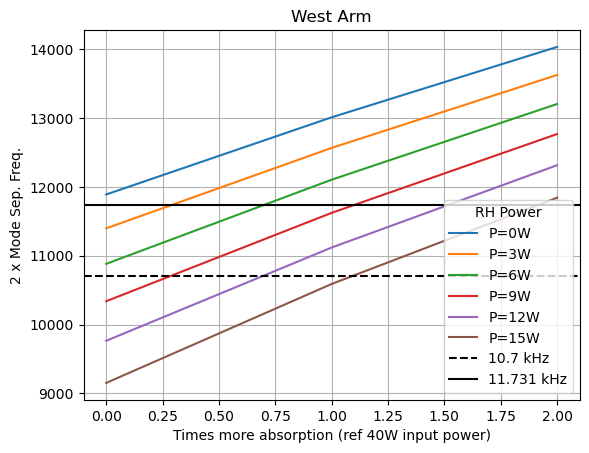
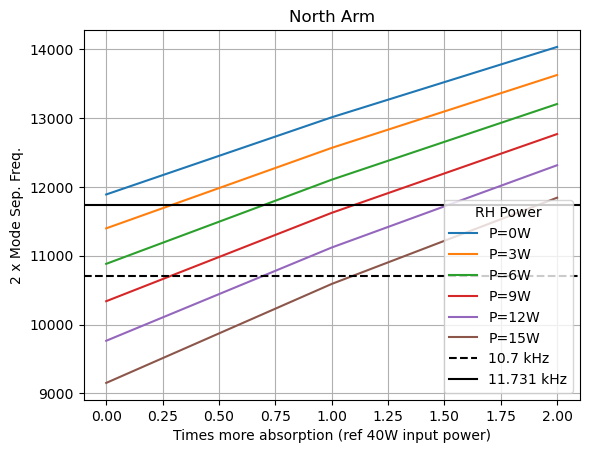
We can then explore the range of 2nd order mode frequencies as a function of absorbtion and RH power, which is shown in the attachements. See the example in Finesse to update your code to use these parameters.
Conclusion: The peak observed by Michal is very plausble as the second order mode freqeuncy. Curvatures for a range of RHs and YAG powers can be computed using the above data.